Shabbat Shalom to all the creative souls! Your time is now.
Shabbat Shalom to all the creative souls! Your time is now.

Shabbat Shalom to all the creative souls! Your time is now.

Shabbat Shalom to all the creative souls! Your time is now.

Shabbat Shalom to all the creative people out there! Your time is now.

 The first writing group I ever attended was at the library where I used to work. I had written for pleasure my whole life, but I never did anything with it. Not that one has to do anything with his or her writing. However, when my friend and co-worker mentioned that she was starting a writing group, I was intrigued.
I joined the monthly meetings without any expectations and a lot of desire and nervousness. No one had ever heard my writing beyond my parents and husband. Now I was being asked to share my work with strangers. Reading aloud in group did not come easily to me, and I didn’t do it as much as I would have liked. Even submitting through Google Groups intimidated me.
I kept going to the group but constantly came away frustrated and angry with myself. Then came the day when I realized the writing group wasn’t a good fit for me. I’ll refrain from listing the reasons why so I don’t sound petty or judgmental. The group still exists at a different location, members have come and gone, but the group is solid and I wish them every success.
I joined another writing group that seemed like what I was looking for, followed a few members from there to a new group, and tried two other groups on a hit or miss basis. I kept writing, editing, querying, and blogging, but I felt unsettled. I’d made wonderful friends in the writers I’d met, so what was missing?
A fellow writer from one of the earlier groups invited me to an informal meeting for writers at her home. She writes mysteries as do the majority of the attendees. The invitation to talk about craft and industry was too tempting. I went mostly to observe, listen, and learn especially since I don’t write mysteries.
If memory serves me correctly, that was close to two years ago. In that time an amazing thing happened. I remember the moment it dawned on me that the seven of us had come to trust each other. Every month we sat around the dining room table talking craft, industry, and so much more. Maybe it was the fact that we were all facing each other. Perhaps it had to do with sharing about our families, jobs, fears and joys, failures and successes. Maybe it’s because the group is small, consistent, and all women. Whatever the reason, I know that each of us looks forward to the monthly meeting with the same excitement and anticipation as one would a trip to Disney World combined with a visit to a great therapist.
The connection the group established spilled over into occasional e-mails, then a weekly check-in, and finally the need for a private means of communication via social media for questions and comments not requiring immediate attention or lengthy conversation. The group is a success because we know we’ll be there for each other. The support is invaluable.
I’m sharing this to stress the importance of finding a writing group that works for you. If you have the desire and initiative, create one. Only you can decide what makes a writing group work for you, so don’t stay in one that isn’t beneficial to your writing life. I know I’m where I’m supposed to be because I hate for the meeting to conclude, I miss my fellow writers/friends before I’m even out the door, and I can hardly wait until we’re together again.
Go forth fearlessly and find your tribe.

 It’s time to take a deep breath and mentally prepare myself for one of my least favorite challenges in my writing life: querying. I remember the first time I queried my novel. I labored over my letter, presenting it to members of my writing groups and submitting it for a paid critique, as if I was writing the Declaration of Independence. Every word had to be perfect. Nothing less than exceptional would do as I crafted this key to unlock the doors to the world of publishing. But never mind the doors; I must first get past the gatekeepers.
Researching agents is a full-time job unto itself. I found literary agencies that represented my genre, and then I located specific agents within the agency. After choosing an agent, I looked to see which authors they had worked with and which titles they represented, hoping to find a title comparable with my novel. Using tips I’d picked up from webinars, I hunted for any connection between myself and the agent. (Did we have similar hobbies and interests, did we grow up in the same state, do they have pets?) All this was before I even sent the letter. Crazy, isn’t it?
Just today my husband wished for me the kind of writing life where I didn’t have to worry about publishing. And what is the concern, really? Can I not create art for the sake of art? Trying to have my work published was my idea. No one forced me to do it. But then I struggle with the question of why write if I’m not going to try to publish, and I start thinking maybe I should find a job. I hate the way money always pops up in my thoughts.
The truth is, I have a supportive husband who isn’t insisting that I find work or publish to bring in a paycheck. When combined with the abundant amount of free time I have, you may wonder what my complaint actually is. Sometimes, I do, too.
There are days I wish I’d never sought publication because I remember how it felt to write freely without that pressure hanging over my head. Don’t think for one minute, though, that I don’t want to be published. Because I do. I’ve invested in my blog and I maintain social media toward the endeavor of publication. My problem is that my two desires are at war in my mind and my heart.
There are also days when I wonder if I’m creating this drama for myself, and I laugh thinking at least I’ll get a good blog post out of it. Because really, it’s better to let this stuff out than it is to hold it in. So again, deep breath.
I am aware of the emotional toll querying can take on a writer, but I’m not ready to abandon my dream. I’ll balance it by realizing how good I have it in that while I’m waiting for replies, I can write freely to my heart’s content. I’ll fill notebook after notebook with words the world will never see. Writing just for me. And once again I’ll…
…Write Happy!

Shabbat Shalom to all the creative minds out there. Your time is now!

 My mother insisted I learn how to type when I was in high school. Since I didn’t plan on becoming a secretary, I failed to see the necessity of the class. She assured me that no matter what field of study I ended up pursuing, I would never regret learning how to type. When I think about all the reports and papers I typed in high school, the subpoenas, notices, and letters I typed as an office manager of a court reporting firm, and the short stories, flash fiction, novels, and blog posts I type as a writer, well, I’m glad I listened to Mom.
I learned on different models of electric typewriters in high school. They were very high tech at the time. The college I attended also used electric typewriters, but it wasn’t long into my education that the school transitioned to computers. Imagine how thrilled we students were. From that day forward, technology has progressed to the point where I’m now typing on a laptop. Things sure do change rapidly.
But one thing did not. My brain and fingers were trained to hit the space bar two times after any punctuation ending a sentence and after a colon. I’ve done it for thirty years, and no one ever said boo about it. Until recently.
It was pointed out to me that I needed to stop this practice. I failed to see the urgency of retraining my brain and fingers, so I continued to let the memory ingrained in my ten digits go about business as usual. Another person pointed out that my long-practiced habit may be viewed as a problem when submitting my work for publication.
I’m going to forgo my thoughts on how this minor detail could cause a major upset in the lives of those who would publish my writing and go straight to helping anyone who may still be placing the extra space after their punctuation. And in case you were wondering, the reason this has changed is because every letter among the fonts one can employee these days receives an appropriate amount of space negating the need for two spaces at the end of a sentence that used to improve readability. Below is an example of what I’m talking about.
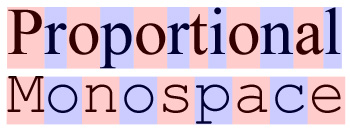 The monospaced font required the extra space. Proportional fonts do not.
Correcting the problem is easy. If I can learn to retrain my fingers to hit the space bar once after punctuation, so can you. As for the documents you already have saved on your computer, there’s a quick fix for that, too.
Open your document
On the Home tab, in the Editing group, choose Replace. Or press Ctrl + H on your keyboard.

In the Find what box, type a period and two spaces
In the Replace with box, type a period and one space
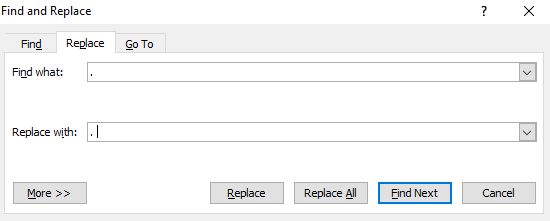
Choose Find Next and click Replace All
Every instance of two spaces after a period will be corrected to only one space. The same steps can be used to remove the extra space after question marks, colons, and exclamation points.
I hope this was helpful to anyone out there who may still be placing two spaces after a period. In closing, let me say one small thing: yes, using two spaces after punctuation may reveal a person’s age, but that does not give anyone the right to point out what has now become an error with anything but tact and grace.

Shabbat Shalom to creative souls everywhere! Your time is now.


Shabbat Shalom to all the creative minds out there. Your time is now!

 hl gibson, author