
God Is In The Details by Mauricio Raffin
Today’s post counts as two entries in The Weight of Words and one for Research Road. It also stresses the importance of thoroughly editing and researching your work as well as finding a good editor. We’ve all made mistakes. I have received tactful comments from followers pointing out errors I’ve made. It’s easy to correct a blog post even after the fact, but what about my novel? I don’t live in fear of discovering an error post publication…oh, wait—I do.
I can’t tell you how many times my mother has said, “What difference does it make if you’re not 100% accurate? The common reader won’t know if you’re right or wrong.” To which I explained that I would know. Then there is the historian or well-read person who may read my novel and nail me for incorrectly portrayed facts. I’m not talking about the creative license we employ when placing our fictional characters in real periods of history or an entire reimagining of historical events such as the Germans winning World War II. I’m talking about modern words and phrases ending up in the mouths of characters from an earlier century and inaccurately portrayed artifacts, architecture, places, etc. due to lazy research.
A book I finished recently had two such errors. The first was the spelling of the word carcase/carcass. About thirty years ago, I read Dorothy L. Sayers’s novel Have His Carcase. It was part of a trio of Sayers’s books gifted to people who made a donation to the local PBS station. The announcer kept mispronouncing carcase the way one would say car case. How embarrassing. Years went by before I stumbled across the spelling carcass, which, by the way, is the only spelling Word recognizes as correct. I assumed it was another instance of American English vs. British English. What I discovered after reading several definitions for both spelling variations, is that carcase is the older, often consider archaic, of the two spellings although both are acceptable. Why is this important? The author of the aforementioned book used the word in the diary of a Carthusian monk from 1535, but she spelled it carcass. As soon as my eyes fell across the word, I was jolted out of the story to ponder whether the mistake was mine or hers. True, most people would have let it go, but for historical accuracy, well, I’ll leave it up to you to decide.
Small sidebar: When I checked writing forums for the correct spelling of carcase/carcass, Dorothy L. Sayers’s novel, Have His Carcase, was referenced at least once on every site as the example for the spelling carcase.
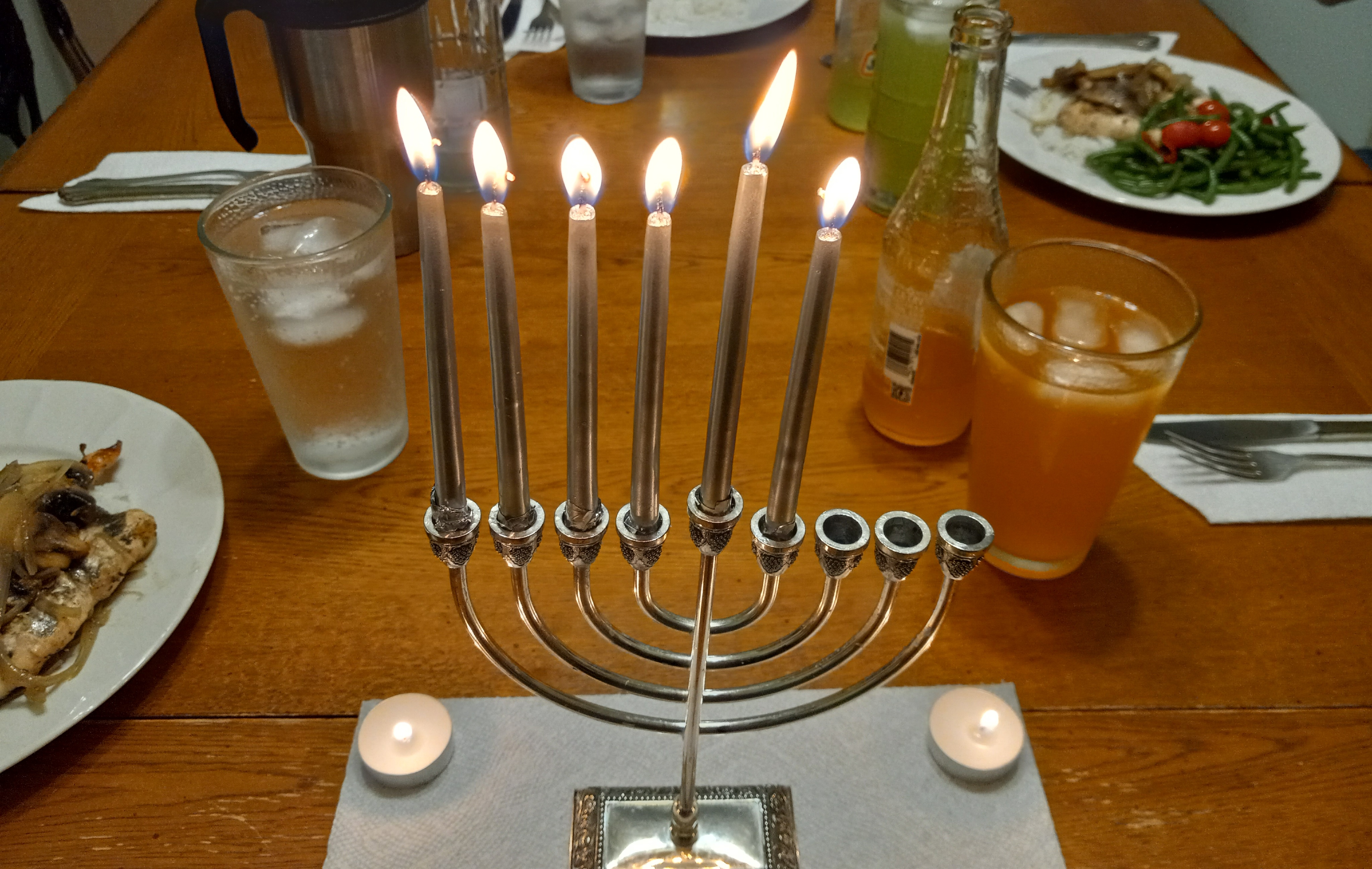
I was much less forgiving toward the second mistake. Another character, also from 1535, mentioned seeing a nine-branched menorah used in the second temple of Israel. Did you catch that? Talk about being shocked right out of the story. All my research on the subject verified what I already knew to be true: menorahs used in the temple of Israel have seven branches. The most reliable source of this information is the Bible. I don’t doubt that the candelabra people see the most and the one with which they are familiar is the nine-branched version known as a chanukkiah used in celebration of Chanukkah. The terms are used interchangeably and incorrectly. However, the two items are absolutely not the same thing.
My thoughts on the subject ranged from disappointment toward the author to wondering if the editor was too young to care about such facts or not interested in verifying them. Several years ago a self-published author gave the advice that you should research your history to the nth degree because your readers will trust that what you have written is true. That advice is what prompted me to research my own novel in minute detail. At one point, I had a fellow author/history buff tracing World War II troop movements to ensure I had placed my protagonist with a unit that had actually ended up in a battle I needed to feature.
Perhaps I sound like a fanatic. Even Andy Weir, author of The Martian, admitted to minor mistakes pointed out by other brilliant scientists, the type of knowledge the common reader wouldn’t possess. There may even be mistakes in my own novel. I sincerely hope someone catches them before it goes to printing. Still, I cannot stress enough that the writing and research of your work in progress begins with you. Beta readers and editors are essential to the process, but there is no excuse for a lazy author.
In closing, I’ll point to the title of this post as my final comment on the importance of using the correct words/phrases and conducting research. You’ve probably heard the devil is in the details and the older, slightly more common phrase, God is in the details. The first means that mistakes are usually made in the small details of a project. Usually it is a caution to pay attention to avoid failure. The second means that attention paid to small things has big rewards, or that details are important. Who is guiding your writing efforts?


 hl gibson, author