The Standards of Prose – Realistic or Ridiculous?

imagesWho gets to decide what makes something good? Or great? I’ve often asked this question about art, books, and movies especially after I’ve read a review.

Does a critic have to possess a degree in the field they are critiquing? Must they successfully produce vast quantities of work in said field before they qualify as worthy to deliver an opinion? Or does simply earning a lot of money doing what they enjoy make them an expert in the field? And, most importantly, do we listen without question when they cast their vote for yea or nay?

These questions have been on my mind as I edited the fourth draft of my novel, The Secrets of Dr. John Welles. Admittedly, I have been (WARNING: cliché ahead) tying myself up in knots trying to predict what the agents I will query, the publishers they will solicit, and any potential readers may want out of my novel. Along the way, I may have even foolishly surrendered what I wanted from my book in my quest for perfection.

Recently, I tortured myself with chapter one rewrites until I met with my level-headed, best friend who talked me through my dilemma and put me back on track. Suddenly, writing was fun again.

But I’d be lying if I said I didn’t have a pea under the mattress of my brain, niggling me with doubts and fears. I reread the first lines, paragraphs, and pages of my favorite books, trying, without copying, to capture the essence of what made them great according to my perception of greatness.

About this time, I came across a brilliant essay written by Daniel Wallace titled Sentence Anxiety. Mr. Wallace eloquently stated exactly how I feel about the standards of prose to which writers must aspire if they want to be considered real writers and/or great writers. I enjoyed the entire essay, but I believe the following paragraph, my favorite, contains the spirit of the piece:

I suspect that most common readers — people who read novels but are not professionally connected to literature — simply don’t read like this. Not only do such readers lack the stylistic precision to tell actual bad writing from, say, Nabokov or Joyce amusing themselves with marginally overblown prose, such readers do not approach books with the professional reader’s exhaustion, his frantic need for newness. Few common readers, I humbly posit, read the opening pages of Harry Potter and the Philosopher’s Stone and cry, “Oh, God, not another school-based bildungsroman!”

After reading the complete article, I would love to hear your opinion on the subject.  In the meantime, I’m going to continue putting all of my efforts into creating my novel. My goal is to not only write good and great sentences, but to write an enjoyable novel that readers will find hard to put down, a book that they will recommend to their friends and family, and a story that will stay with them long after its conclusion.

Staring Down the Barrel of Chapter One

Staring Down the Barrel of Chapter OneI have heard that the first chapter of a novel is the most rewritten chapter of all. I have also heard this is because everything that we want our novel to be and everything that it should be comes spooling out of those first words, sentences, and paragraphs. If the groundwork for the rest of the book isn’t compellingly laid out for our potential readers, and if our readers aren’t hooked by our initial efforts, our novel is doomed. No pressure there.

For the past week, I have been staring at the pages of the first chapter in my novel, The Secrets of Dr. John Welles. Based on the paragraph above, you can probably guess what my current goal is. Still, I refuse to force my story into an outline or someone else’s expectations and/or opinions of what my novel, as a whole, should be. I will, however, accept advice that helps me tell my story the way I know it needs to be told.

Today, I’m stocking my Writing Toolbox with two pieces of writing advice relevant to my situation. The first comes from Jacob M. Appel’s March 29, 2011, post for Writer’s Digest, 10 Ways to Start Your Story Better. I’ll be employing a combination of Mr. Appel’s suggestions to refine the essence of my first chapter.

The second, more recent piece of writing advice is from K.M. Weiland, Most Common Writing Mistakes, Pt. 38: Irrelevant Book Endings. I’m exploring the end of my novel to ensure that the beginning of my book set up my desired ending. If not, a chapter one rewrite and restructure may be in order.

Somewhere, an outliner is screaming, “You could have avoided this if you’d only outlined to begin with.” That may be true, but I enjoy exploring the rabbit trails too much. It’s where I often receive my next piece of writing inspiration, and I’m certainly not interested in turning off the creative supply outlet.

Handling Those Pesky Info Dumps

untitled (6)Recent comments from a beta reader generated concern regarding two passages in my novel, The Secrets of Dr. John Welles. In her insightful critique, she tactfully suggested that the two aforementioned passages might come across as info dumps.

I realized this before I sent my novel out for the initial round of beta reading. The offending paragraphs were pared back considerably and again upon return. Still, a round-two reader thought them a bit excessive.

I decided to go in search of advice on how to handle info dumps and to discover whether or not they are the evil creatures we’ve been led to believe. The second part of this quest was in response to the fact that I’ve read brilliant fiction by well-known and new authors who info dumped to their heart’s content.

Author Jami Gold supplied the guidance I was looking for as well as a remedy in her blog post, Four Tips for Fixing the Infamous “Info Dump. What Ms. Gold suggested applies to all genres. I recommend using the tips as questions to ask yourself, then honestly answering them, to see if you truly wrote an info dump or not.

The questions and answers helped me to focus on what needed to be rewritten or left alone. Editing became much less daunting, and I didn’t feel as if I had to cut crucial information from my story. Thanks again to Jami Gold for helping to stock my Writing Toolbox.images

What Can You Show Me?

What Can You Show Me

Some day, I want someone to tell me where the advice Show, Don’t Tell came from.  I’m pretty sure all during my childhood, I never once said, “Mommy, show me a story.”  Until then, I’ll dodge the flack I receive for that comment and do my best to conform to the rules.

With that being said, I’m stocking my Writing Toolbox with the post Show, Don’t Tell: Revealing True Emotion In Dialogue by Angela Ackerman of Writers Helping Writers.  Ms. Ackerman supplies five very helpful tips on how to do this.  She even goes one better when she responds to the same question asked by another follower and myself.  Her example of how to employ her suggestions are detailed yet easily understood.

I believe we can all benefit from this.

Beta Reading Etiquette

Beta Reading Etiquette

Today’s post is in response to a request I made of one of my favorite writing gurus, K.M. Weiland.  No big surprise there as I am always stocking my Writing Toolbox with posts from her site that I find extremely helpful.  As I said before, I may not always have the advice myself, but I do know where to find good advice when I need it.

That being said, I hope you enjoy K.M. Weiland’s blog post, A Quick Guide to Beta Reader Etiquette.

Keep Those Emotions in Check

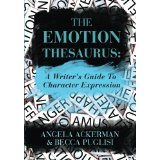
51j0JxV-MZL._AA160_Today I am stocking my Writing Toolbox with a book recommendation.  I first came across The Emotion Thesaurus: A Writer’s Guide to Character Expression when I stumbled across the authors’ website, Writers Helping Writers.  This was during the days when my own author platform was being created, and I clicked on and followed anything and everything that looked as if it might be valuable.  The point being:  I didn’t give the book much of a glance.

Of course, posts from the site kept leading me back to The Emotion Thesaurus as well as mentions on other writing blogs.  I checked out the book on Amazon, and I decided I must have it.  And by must have it, I mean I asked my local library to purchase it.

The simplicity of the book is brilliant.  Ms. Ackerman and Ms. Puglisi did a wonderful job explaining how to write emotional responses well.  The book includes a long list of emotions with examples of physical signals, internal sensations, mental responses, cues of acute or long-term confidence with other emotions to which the original one may escalate, and cues of repressed desire.  As well done as all of the above-mentioned features are, what I liked best about the book was the authors’ admission that their book is a launching point.

The Emotion Thesaurus is meant to help each and every one of us writer better, not to copy verbatim from the list of emotional responses.  This simple book gently pushes and guides one to think beyond the usual, clichéd responses.  It presents one of my favorite things in writing:  malleable rules.

I hope you find this book as helpful as I did.

Writing Inspiration

This morning, I seriously entertained the thought of chucking it all and applying at the local grocery store.  This writing/author thing is hard.  The thought of disconnecting from social media, abandoning my author platform and potential audience, and leaving behind the fear that comes from staring at a blinking cursor on a blank page sounded wonderful to me.  I realized I needed more encouragement than Mom or my husband telling me I could do it.

Thank you Anne Leigh Parrish for coming to the rescue.  What it Takes to be a Writer was the kick in the pants I needed to go on.  Mrs. Parrish didn’t candy coat the fact that writing is hard.  Instead, she offered ways to overcome the nagging doubts.

In the same vein of thought, I would direct you to Neil Gaiman’s speech Make Good Art.  I usually think of art as a painting or sculpture in a museum or gallery, but I needed to change my perspective about that.  Anything we have created, including writing, is art.  No matter how long it takes or how many times we mess up, keeping pressing forward.

Enjoy!

Tackling Chapter Breaks

Ah, the chapter breaks. How do we write them in such a way as to keep the reader hooked? Admittedly, I like a cliff hanger as long as it doesn’t come across like the Friday episode of a soap opera.

The advice in 4 Ideas for Ending Book Chapters So Readers Will Kill to Know What Happens Next is another helpful tool for my writing toolbox. Not surprisingly, it’s by K.M. Weiland. The four ideas presented in her post are subtle changes intended to keep the reader desiring more without the cheesy cliffhanger effect.

Enjoy!

To NaNoWriMo, or not to NaNoWriMo, that is the question

I first heard about NaNoWriMo two years ago from my friend who heads our Writer’s Group. The idea of writing 50,000 words (an entire novel) in thirty days was both exciting and terrifying. As luck would have it, I had been kicking around an idea for a great novel. NaNoWriMo seemed like a good way to get the story out of my head and onto paper.

Before NaNoWriMo, I wrote short stories and children’s stories of picture book length. I had never heard of outlining a novel which might have been helpful for my first NaNoWriMo experience. Undaunted, I began writing near the end of the book leading up to the scene that was the catalyst for the whole novel. That’s when I realized I needed to go back to my character’s beginning. My first experience with NaNoWriMo was a jumbled mess.

I reached my goal of 50,000 words but didn’t have a complete novel. There was more to the story than I originally thought. The rest of the year was spent creating those portions while editing and chucking large sections of what I wrote for NaNoWriMo. I began to wonder if my November efforts had all been for naught when NaNoWriMo rolled around again. What to do?

I cheated again. I used the 50,000-word goal to keep writing new stuff my novel needed and editing what I had written last year. Perhaps the Deities of NaNoWriMo would smack my fingers with a ruler for this, but I justify what I did with the explanation that at least I wrote.

This year marks the third NaNoWriMo since I first participated. I didn’t join. I also didn’t use it as a motivational tool for rewrites and editing. I let myself off the hook with the understanding that my schedule and novel were in different places than what NaNoWriMo required. In short, I didn’t have the time and there wasn’t anything new to write or edit to meet the word count. I also didn’t want to start another novel when I already had one under way.  I’m not sorry for having tried NaNoWriMo, and I’ll probably do it again. In the meantime, I shall continue working on my second round of editing and looking for beta readers.

If you’re trying to decide whether or not NaNoWriMo is for you, consider the following article by Christopher Shultz. He’s much more eloquent in his explanation of what one needs to consider before jumping feet first into NaNoWriMo without knowing what it’s all about. I agree with his opinion that one should make NaNoWriMo work for him/her and that it isn’t a ‘must’ or ‘mustn’t’ situation in the life of a writer.

Blood-Red Pencil: Things That Drive An Editor Crazy

Today’s advice comes from The Blood-Red Pencil, a weblog hosted by a team of editors.  The post I’m sharing was written specifically by Maryann Miller, author and freelance editor.  Her post originally ran October 7, 2008.  I know you’ll find her advice is every bit as relevant today.  Enjoy! 

Blood-Red Pencil: Things That Drive An Editor Crazy.