Photograph

Zara wrenches the key from the lock as she pushes the door open and calls, “Jan, where are you?”

A feeble voice from the bedroom replies, “In here still.”

“How pathetic,” Zara mumbles.  She slams the door shut with her foot and tosses Jan’s spare keys on the countertop.  Six plastic shopping bags, two to an arm and one in each hand, cut into the sleeves of her jacket and across her palms.  She hoists the bags upward with a groan and deposits them beside the splayed keys.  A quick survey of the apartment reveals that Jan hasn’t made much progress in the hour Zara has been gone.

“Oh, hey…you brought food,” Jan says.  “Thanks.”  Her slippered feet scuff the hardwood floor as she shuffles into the living room.  She wears a nappy, pink robe over the faded Superman t-shirt and sleep pants Zara found her in that morning.  A black and white photograph in a silver frame rests against her chest, safely embraced within her arms.

“I thought we agreed you’d start clearing out Jay’s stuff while I was gone,” Zara says.  She shoves perishables on the refrigerator shelves, cans and boxes in the cupboards.  Then she turns her attention to the newspapers and magazines strewn across the coffee table, couch, chairs, and floor.

“You don’t have to do that,” Jan says when Zara scoops up a stack of Jay’s photography magazines.

“Yes, I do.”

“No—you really don’t have to do that.”

Panic and annoyance strain Jan’s voice.  She abandons the photo on an end table to follow Zara to the garbage shoot in the hallway.  A brief wrestling match ends with the magazines scattered across the hallway floor.  Zara plants balled fists on her hips and taps one Christian Louboutin; the red sole is soundless on the sculpted carpet.  Jan cannot look at her best friend when she stands with the magazines clutched to her heart.

“I’m not ready to let this stuff go yet,” she offers as an apology and walks back to her apartment.

Halfhearted attempts at straightening no longer appease Zara, and she knows it’s time to confront Jan.  She lures her friend’s attention by sitting on the couch with legs crossed, arms folded.

“I thought you said we should get busy cleaning,” Jan says.

“It’s past the time for cleaning, Jan.  We need to talk.”

“It’s too soon.”

“No, it’s been three weeks since Jay left you for his assistant, Chrissy, and in those three weeks you’ve allowed your life to—I don’t know—something between fall apart and explode.”

“Are you judging me?  How can you expect me to deal with this right now?  I didn’t think you’d be so cruel.”

“Oh, spare me.  Just because everything in your world is going to hell in a handbasket doesn’t mean it’s affected everyone else.  I haven’t changed, and for that you should be glad.”

Shock etches Jan’s face, drawing her brows downward, and she says, “Damn, I admit I was just trying to buy some time, but you really are being mean and hurtful right now.”

“You need me to play it straight with you,” Zara says, punctuating the air with a condemning finger.

Jan knows this to be true.  She crumples into an armchair, still holding the glossy magazines.  Emotions sting her eyes.  She sniffs hard to keep from sobbing and pulls a wadded tissue from her robe pocket to dab at the wet trails on her cheeks.

“I’m just so embarrassed.  In front of all my friends and family.  My co-workers even.  For something like this to happen.  I mean…no one—no one—saw it coming.  Least of all me.”

Zara remains seated, aware that this little outburst confession is Jan’s way of softening up the other person thereby distracting them from what needs to be dealt with.  It would be so easy to slip into the crowded space of the overstuffed armchair and wrap her best friend in a hug.  But then Jan would never get out of Jay’s old pajamas and on with her life.

Instead, Zara claps her hands with a slow, rhythmic beat.  Twenty claps before Jan bursts out, “Okay—fine!  What the hell do you expect me to do?  You’re so smart?  You have all the answers?  Well, I’m listening.”

“Getting pissed off about this is a start.  At least I know you’re still alive, that there’s a hot-blooded woman in there.  You used to be so strong—”

“I am strong, Zara.  I’m just tired.”

“Yes, well, stewing in your own misery isn’t the answer.”

“Then what is?”

“Tell me something, Jan.”

“What?”

“How is it that you can wear his pajamas and sulk around this apartment all day, holding photographs that he took in Hawaii and act as if Jay’s not the reason you’re so miserable?  I mean, he up and left you in a single, freakin’ day!  Who does that?”

“Obviously Jay does.”

Zara startles when Jan bursts out in maniacal laughter.  She uncrosses her arms and leans forward, ready to catch her friend if she starts running and shrieking hysterically, which is exactly what Zara expects from her friend right now.

“Oh, oh my god…how did I fall to such depths?” Jan asks through laughter and tears.  “And don’t even think of saying this isn’t my fault.”

“It’s not your fault.”

“Yeah, well, maybe Jay leaving me isn’t, but allowing myself to get like this is.”  Jan indicates her unwashed, disheveled appearance with both hands.  The magazines fall from her lap as she stands, spilling into the piles at her feet.  “You know what’s been on my mind today?”

“What, honey?”

“Will that bitch show up at Jay’s funeral or will she be granted calling hours of her own?  You know, like when feuding families host separate baby showers or something?”

“Oh, Jan…”

“Now that his body washed up on shore, it’ll be sent back to me.  The wife.”

“Do you need me to go with you to identify it?”

“No, his brother flew down to Cozumel to do that.  Then there was a bunch of paperwork, and the authorities acting all superior because Jay’s brother is American, and finally they cleared the body for shipping.  So much for their Caribbean vacation.”  A derisive snort is on the cusp of more crazed laughter, but Jan reigns in her emotions.  “The body.  Because that’s all Jay is anymore.”

“I guess what I don’t understand is why you aren’t furious with him for what he did.”

“You want me to hate him, I know you do, but I can’t, Zara.  There wasn’t enough time for me to become angry with Jay as the cheating husband.  He left me on Friday and died on Monday when his boat capsized in a storm.  For me, he was still the man I loved, the man I married.  Does that make sense?”

“I suppose so.  No, not really.”

“If he hadn’t drowned in that storm, if he and Chrissy were still touring the world and taking gorgeous, award-winning photographs for prestigious magazines a year from now, then yeah…I’d be looking at this from a whole different perspective.”

Zara sighs and tosses her head from side to side.  She still cannot comprehend Jan’s passivity, but she hopes to give the appearance of understanding.

“All right, then.  The order of the day is to find a new perspective for you,” Zara says.  “One for you, about you.  Okay?”

“What does that mean?  I’m still not quite ready for any major changes.”

“The only thing you need to do right now is get out of those smelly pajamas and into a hot shower.”

“That’s it.”

“One thing at a time, Jan.”

“Then what?”

“Then we’ll see about getting some orange juice—”

“The orange juice turned.”

“How the hell does orange juice go bad?”

“I don’t know, but the last time I tasted it, it was fizzy.”

“That’s disgusting.  Okay, shower first then tea and toast afterward.  One little thing at a time.”

“That’s your big answer for fixing my life?  A shower, tea, and toast?”

“I don’t have the answers for your life, Jan.  You do.  I’m just here to help you unearth them.”

Room Service

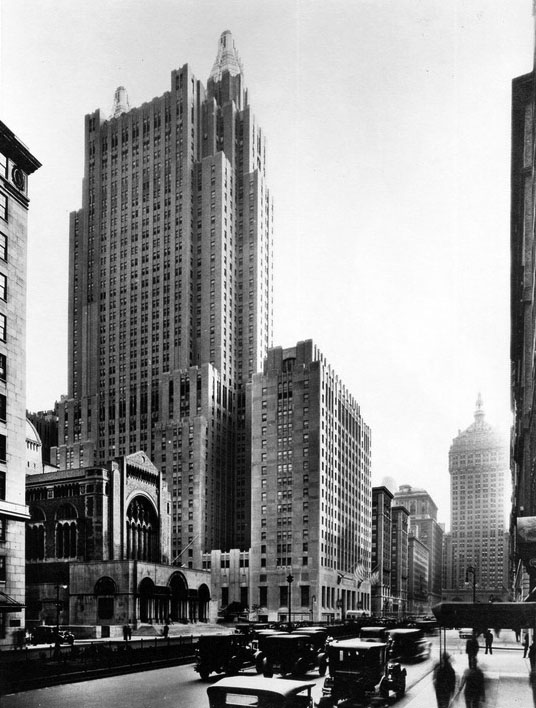
Photo by Richard Averill Smith (1935)

Funny how a tidbit of fact checking can lead to some interesting reading and a blog post.  I simply needed to make sure the hotel I wanted to feature in my novel, The Secrets of Dr. John Welles, was indeed open for business in 1935.  I had a pretty good idea that the Waldorf=Astoria had been built and would be available for John’s best friend, Claude Willoughby, and his wife, Patsy, to spend the first night of their honeymoon in the lap of luxury.  Still, I’ve been burned before on assuming facts for my novel, so I conducted a little research to make sure the hotel wasn’t closed for remodeling or some other detail that would prevent me from mentioning it in my book.

As soon as the fact was confirmed, I could have stopped.  After all, I simply needed to say where Claude and Patsy spent their first night and that it was a gift from Claude’s grandparents.  But it’s the Waldorf=Astoria, and the opulence, that drew me in.  I won’t waste your time with overwhelming amounts of useless history.  Rather, I’ll skip right to the interesting facts and secrets.

For instance, did you know how the “=” came to be the official symbol in the title Waldorf=Astoria?

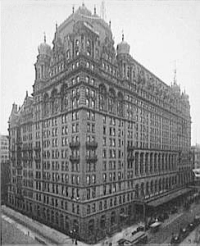
The roots of this New York institution go back to 1893, when millionaire William Waldorf Astor opened the 13-story Waldorf Hotel on the former site of his mansion at Fifth Avenue and 33rd Street.  A private bathroom in every guest chamber and electricity throughout were two on a long list of Waldorf firsts.

Four years later, the Waldorf was joined by the 17-story Astoria Hotel, erected on an adjacent site by Waldorf’s cousin, John Jacob Astor IV.  The corridor connecting the two buildings became an enduring symbol of the combined Waldorf and Astoria hotels, represented by the quirky “=” the Waldorf=Astoria uses instead of a hyphen in its official logo.  In 1929 the original Waldorf=Astoria was demolished to make way for the Empire State Building.

The new hotel cost $42 million and was the largest and tallest hotel at the time, having 1,852 rooms and 42 stories.

And here’s some other interesting information regarding the Waldorf=Astoria per luxury suite specialists, “The Jackies,” better known as Jackie Collens and Jackie Carter.

The most requested suite is the Presidential suite.  When a president stays there, bulletproof glass is installed.

There’s an underground railroad that runs from Grand Central Terminal to the fourth floor of our basement.  When Franklin Delano Roosevelt was the sitting president, that’s how they would bring him in because many people didn’t know he was in a wheelchair.

Old Waldorf=Astoria Hotel

The largest suite is 33A:  The Cole Porter.  It’s a five-bedroom, five-and-a-half bath configuration suite that’s about 4,300 square feet, which typically rents out on a monthly basis.  Prices start at $150,000.  Porter lived there for 25 years and wrote a number of famous songs [in the room]; one of his biggest was “You’re the Top” from Kiss Me Kate.  His piano is still in the suite, one more reason the room is so popular.

After Porter’s death in 1964, Frank Sinatra took over the lease, and he and his wife Barbara lived there until 1988.  Rumor states that they etched their initials into the bathroom door but the door was apparently removed during renovations, and its whereabouts are unknown.

President Herbert Hoover was here from 1932­–1964, and President Dwight Eisenhower stayed from 1967–1969.  He and his wife lived in suite 700R because his wife had a fear of heights.  To accommodate them, we had the elevator specially designed to open on the 7th floor.  General Douglas MacArthur lived with us from 1952–1964, which is when he passed away.  His wife continued to live here until her death in 2000.

The Elizabeth Taylor has the largest and most exquisite bathtub which can easily accommodate three people.  The pillows in the master bedroom of the Royal Suite were created to resemble the Duchess of Windsor’s pugs.  Douglas MacArthur’s master bathroom was designed with a constellation on the ceiling.

The hotel was the first to use red velvet ropes (outside the Palm Room restaurant) as a way to create order among the people crowding the entrance.  Access was granted only with a reservation, another first; the fact that it created a sense of stature and separation was secondary.  They also created rooftop happy hours.

The history-filled hotel is a magnet for guests with sticky fingers, and the items that disappear the most are teakettles, silverware, teapots, plates, and ashtrays.  Once, a candelabrum was taken.

Oscar Tschirky, who is known globally as Oscar of the Waldorf, is credited with creating the Waldorf salad.  It originally contained sliced apples, raisins, celery, cherries, and walnuts, and was lightly covered in a sugared mayonnaise dressing.  Today truffle oil has been added to the mix.

There are many other pieces of history and fun secrets about the Waldorf=Astoria, too many to include, so I’ll leave you with this article, Dear Waldorf, Mummy Stole Your Teapot Back in 1935. So Sorry.  The amnesty program wasn’t so much an effort to recoup stolen items as it was an attempt to generate attention on social media.  I’d say it worked.

~~~~~

“Waldorf=Astoria Hotel – New York City.” Waldorf=Astoria Hotel – New York City, http://www.nycago.org/Organs/NYC/html/WaldorfAstoria.html. Accessed 7 May 2017.

Strauss, Alix. “The Secrets of the Waldorf Astoria Hotel.” CNT. Condé Nast Traveler, 05 Oct. 2016. Web. 07 May 2017.

Quote vs. Quotation

Today’s The Weight of Words came about because I was looking up the proper usage of single and double quotes and came across a debate on the words quote versus quotation.  I wish I could find the original article as the author thereof was quite adamant about not using them interchangeably.  Articles I’ve found since have been a lot more lenient but no less informative.

I’m also featuring this today because I’m using it to launch Quotation Station.  It’s been on my mind for some time as I read books and perused the Internet to share quotations I came across that struck me as intelligent, wise, funny, poignant, relevant to writing, or any combination thereof.  My goal is to feature three posts a week, but I feel as if I’m leaving my followers hanging over the weekend.  Quotation Station will be a sincere handshake as we part company from Friday to Monday to relax from the hectic week.

Per Richard Nordquist writing for ThoughtCo.:

In formal English, quotation is a noun (as in “a quotation from Shakespeare”) and quote is a verb (“She likes to quote Shakespeare”).  However, in everyday speech and informal English, quote is often treated as a shortened form of quotation.

The noun quotation refers to a group of words taken from a text or speech and repeated by someone other than the original author or speaker.

  • direct quotation is a report of the exact words of an author or speaker. Direct quotations are placed inside quotation marks.
  • An indirect quotation is a paraphrase of someone else’s words:  it reports on what a person said without using his or her exact words.  Indirect quotations are not placed inside quotation marks.

The verb quote means to repeat a group of words originally written or spoken by another person. In informal speech and writing, quote is sometimes used as a shortened form of the noun quotation.

Nordquist, Richard. “What’s the Difference Between the Words “Quotation” and “Quote”?” ThoughtCo. N.p., 03 May 2017. Web.

For examples, usage notes, and practice enjoy reading the article in its entirety here:  “What’s the Difference Between the Words “Quotation” and “Quote”?

Don’t Compound Your Problems

Full Moon Cats by AliceinParis (Shelagh Duffet) available on Etsy

You may not have known what it was called, so you couldn’t even Google the answer, but I’m here to tell you, friend, it is compound possession, also known as joint possession!  That’s right; it’s that tricky little scenario that makes your fingers falter across the keyboard when you’re writing about two subjects in possession of something.  Does each subject have an apostrophe and an S or does only the last subject in the group have the apostrophe and the S?

For instance:  George and Mary’s cats are always escaping.

From this sentence, we can assume that George and Mary live together and are in possession of a herd of fugitive felines.  The rest of the story would probably bear this out.  But what if George and Mary are actually neighbors in possession of separate mobs of moggies who escape for midnight sessions of group yowling on the fence between their properties?

Then the sentence would look like this:  George’s and Mary’s cats are always escaping.

Your decision will be based on whether or not the two subjects are in possession of shared items or separately owned items.  You may be saying, “Yes, but George and Mary both owned cats, and since cats are the same thing, shouldn’t it always be like the first example?”

Consider this:  George’s and Mary’s coats are in the front closet.

Clearly, George and Mary aren’t going to wear the same garment.  They own separate coats.  The same applies to their cats.  Now if George and Mary could just contain their wayward beasts, the rest of the neighborhood could sleep in peace.

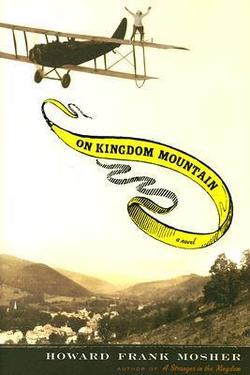
On Kingdom Mountain

On Kingdom Mountain, set in Vermont in 1930, revolved around the character of Miss Jane Hubbell Kinneson, an incredibly eccentric mountain woman who carved birds, ran a bookstore, and was the last of her family to live on Kingdom Mountain.   At first Miss Jane’s forthright nature can be a little annoying; she reminded me of Anne of Green Gables on steroids.  Still, when she used her wits to deal with her cousin, Eben Kinneson, as they battled over the road he and the town fathers wanted to run over her mountain, I found myself rooting for Miss Jane.

Intertwined with the battle over Kingdom Mountain was the story of Henry Satterfield, the rainmaking aviator and grandson of a thief who stole Civil War gold and supposedly hid it on Miss Jane’s mountain.  A charming romance between Henry and Miss Jane ensued, and they worked together to solve the riddle of the missing gold, which was bound up in the mystery of her long lost uncle.  Unfortunately, the biplane pilot’s heart was set toward finding the lost treasure more than it was on making Miss Jane his bride.

My only complaint with the story was Miss Jane’s overwhelming lack of respect toward God.  Her words and actions on that topic were rooted in arrogance and ignorance.  Then again, if she didn’t agree with the writings of a secular author, she simply penciled out what they had written in a book.  So, it probably shouldn’t have surprised me that she would do the same with a Bible.  Her inflexible nature caused her a lot of heartache, yet she never seemed to learn from it.

Many interesting peripheral characters were sprinkled throughout (the dog-cart man, Canvasback Glodgett, A Number One, and Sadie Blackberry) as well as rich history on the era and setting.  Rooted in his own family history, Howard Frank Mosher has written an often hilarious, sometimes melancholy tale about a simple way of life up against the encroaching threat of modernization.