The Martian by Andy Weir

The Martian by Andy Weir is an enjoyable read. I’m not sure it was the best choice in books as I was still coming down from my high after Night Train to Lisbon, but light reads are good for balancing out the heavy stuff.

Written mostly as journal entries by abandoned astronaut, Mark Watney, the endless explanations on the necessary procedures conducted to survive life on Mars were tedious. I often felt as if I was reading an article from National Geographic or a really interesting survival manual. I skimmed a few descriptions until I found the story again.

Andy Weir has proven that he knows his technical stuff, but he delivers it inelegantly and without passion. I don’t need to know exactly how many molecules of various elements are produced when splitting hydrazine nor do I need to know how much power is required to do so. All I need to know is that it’s dangerous. Besides, how many of us could actually refute the science?

untitled (5)The diary entries came across as mild locker room humor mixed with surfer dude attitude and undermined any real tension in the plot. We’re told this is how Mark Watney deals with stressful situations. A more professional approach on the part of the main character with less “ugh, whee, yay, and boo” in his responses would have gone a long way to making me believe in the seriousness of the situation and that he was a highly educated person suitable for space travel.

We’ve been here before with Apollo 13, Castaway, and mostly recently, Gravity. Even Robinson Crusoe was a survivor story. The Martian lacks in respect to these stories because beyond saving Mark, there is no human side to the story. There is no wife or girlfriend waiting on Earth, no foul play to his situation that he needs to discover, not even a friend to whom he needs to make an apology for having spoken harshly. In short, there’s not much in the way of human interest for Mark Watney.

The second way in which The Martian differs greatly from these stories is that it’s pure fantasy. Obviously Apollo 13 is real and the other tales could actually happen. Travel to Mars and/or survival on Mars is still pretend. I find it’s easier to relive historical tragedies than get caught up in the drama of make believe. But that’s just me.

The story was mildly predictable in terms of the sequence of trials and tribulations Mark had to endure on Mars. No sooner would he triumph, I’d turn the page and right on cue the next crisis would appear. The constant up and down was interesting but not as suspenseful as everyone is claiming. This is most evident when thirty pages into the book, Mark wonders if he’s going to blow himself up undertaking an experiment. With about 92% of the book left to go, I’m pretty sure he’s not going to die. Result: zero tension.

Still, Andy Weir’s book is fun. If you’ve worked your way through all your DVDs of Star Wars, Star Trek, and Dr. Who, I recommend reading The Martian. If you’re not a reader, you can wait for the movie which, according to IMDB, is due out in November, 2015.

Night Train to Lisbon by Pascal Mercier

imagesURRVLO8TToday I finished reading one of the best examples of literary fiction I have read to date. Night Train to Lisbon by Pascal Mercier, pseudonym for author Peter Bieri, follows the story of Swiss language professor, Raimund Gregorius.

An unusual encounter with a beautiful Portuguese woman is the catalyst for Gregorius’ journey to Lisbon. His roadmap is a book by Amadeu de Prado called The Goldsmith of Words. So elegantly written are the passages of this fictional book that many have gone in search of it as well as its equally fictional author.

With Prado’s words guiding him, Gregorius delves deeper into the mystery surrounding the life of the enigmatic author, doctor, and resistance fighter during Salazar’s dictatorship. He meets friends and relatives of Prado who piece by piece put together a picture of who Amadeu Prado was.

Upon conclusion of the novel, I felt as if I was leaving old friends behind. Traveling with Gregorius from his mundane existence in Bern to the rediscovery of life in Lisbon proved to be extremely satisfying. The philosophical questions posed in the book are not for the timid or easily offended. Still, I would highly recommend Night Train to Lisbon as an extremely worthy read.

Favorite Author & Multi-Book Review

untitled (6)Joanna Trollope is my favorite writer when it comes to working through the family situation. Her well-written characters are as diverse as the personalities one encounters in his or her own family and just as frustrating. I’ll no sooner have my favorite characters chosen only to have him/her say or do something completely stupid, and my allegiance changes to the character I used to hate. In this way, Mrs. Trollope reels you in and casts you back throughout the story.

The way in which she presents real-life, everyday situations isn’t boring in the least. Her ‘fly on the wall’ perspective into the lives of her characters offers the same guilty pleasure as witnessing private conversations and/or arguments.

Further, her conclusions aren’t always neat and tidy happy endings. Much like real life and family, there is a definite end to the situation, but rarely does it go well for everyone. You’ll struggle, suffer, rejoice, and celebrate right along with Mrs. Trollope’s characters, often identifying with them or recognizing them in your own family members.

I haven’t read everything written by this author, and I haven’t experienced her writing under her pen name Caroline Harvey. What I have read has been enjoyable, the most recent being Daughters in Law. Her novel, Other People’s Children, received my strongest reaction. As expected, the book is replete with interesting characters in different walks of life. There is, however, one character in particular who I fantasized killing in the most heinous ways imaginable long after I had finished reading the book. That may sound horrible, but I believe it’s testimony to Joanna Trollope’s excellent writing skills.

Here is a list of Joanna Trollope’s novel in order of publication.

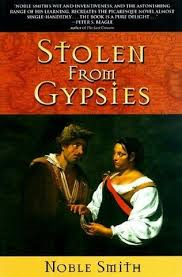
Stolen From Gypsies by Noble Smith – Book Review

untitled (6)Ambrogio Smythe is a hypochondriacal British nobleman living in a miserable world of his own creation. The frail aristocrat is obsessed with memories of gypsies from his childhood, plagued by delusions of grandeur.

During the war between France and England, Ambrogio willingly strands himself in Tuscany with his faithful yet filthy servant, Antonio. In truth, he fled because he could not stand by and watch the woman he loved accept the hand of another.

While in Tuscany, Ambrogio endeavors to write his version of a swashbuckling tale based on a scrap of parchment purchased from a wandering storyteller. In the style of The Princess Bride with a heavy dash of The Bard and a large pinch of Monty Python, author Noble Smith weaves an adventurous, laugh-out-loud tale within a tale.

Magicians, spells, ravishing beauties, unlikely heroes, pirates, demons, and a useful glossary of archaic terms all serve to make Stolen From Gypsies an enjoyable read. Why it hasn’t been printed seven by seven times, bound in fine Morocco leather, and sent to the finest universities in Europe is beyond me.

The Debt to Pleasure – Book Review

Thank you, Lugo Mez (My Emerald Heart), for recommending The Debt to Pleasure by John Lanchester.  What a deliciously wicked tale, involving food, told from the villain’s perspective.  I enjoy a well-written bad character, the one I love to hate, and this book certainly doesn’t disappoint.  The clues leading up to the conclusion are well-placed within the ramblings of madman connoisseur, Tarquin Winot.  The recipes for food and drink are simple, elegant, and not to be ignored lest you bring the wrath of Tarquin down upon yourself.

I don’t own this book, but I must have it has part of my private library.  The fact that I’ve already read it doesn’t diminish its desirability in any way.  This one is definitely going on my Christmas list.