How do you make a candle last forever?
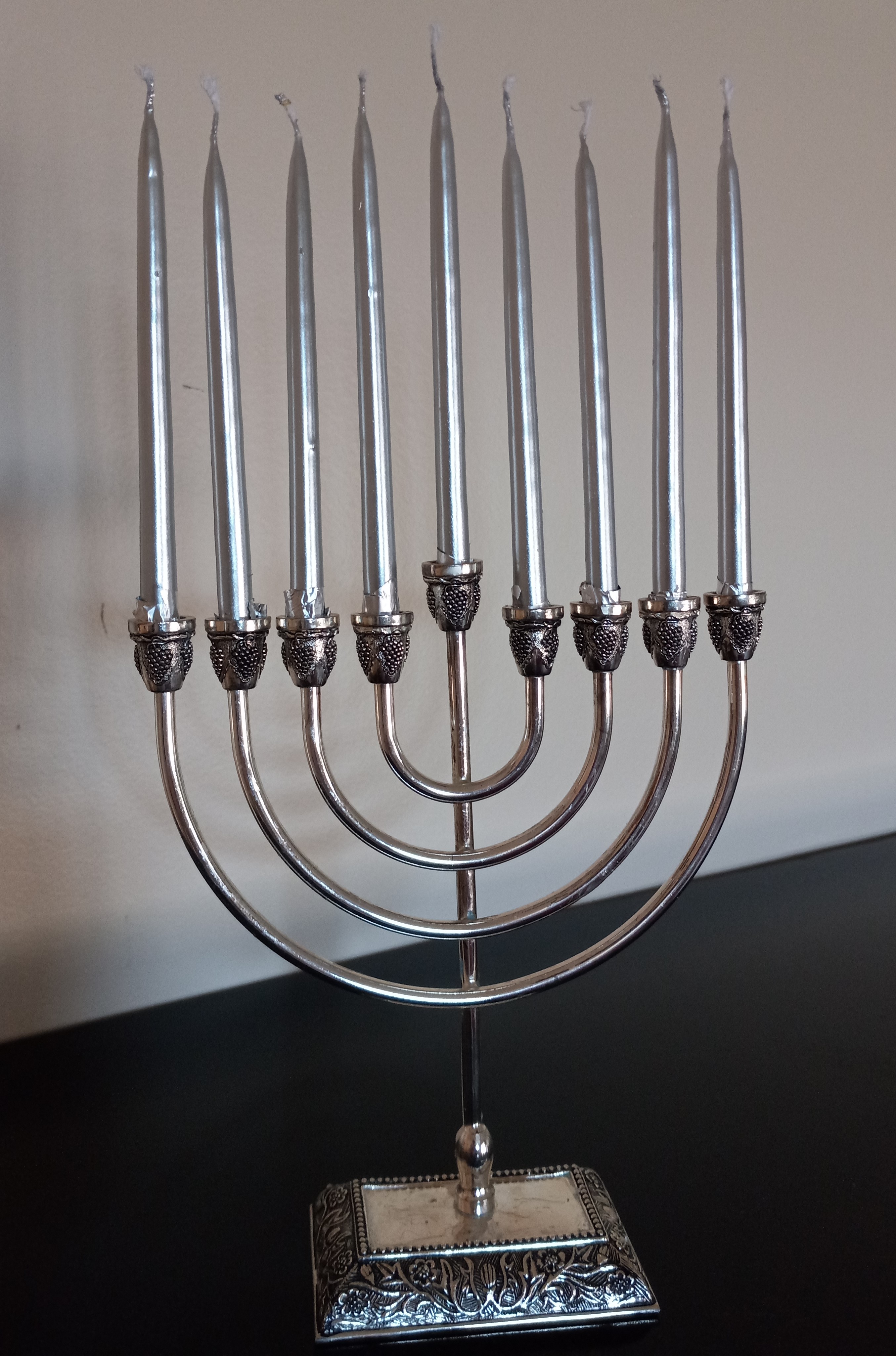
As I reflect on the past nights of Hanukkah, the first thing that comes to mind is the light. We start by lighting the shamash (servant) candle that is placed in the middle of the hanukkiah, and then we use the shamash to light the other candles. The first night, it’s just one candle and the shamash, but each night another candle is added until they total eight. What starts small grows into beauty and brilliance.
I know many menorahs and hanukkiahs are fashioned with the shamash at one end, but there’s a reason why it belongs in the middle. At most, maybe slightly raised or set in front of the other branches.
It’s all about balance.
Read Torah to see that Adonai Himself designed the menorah, and because He did, the menorah is perfect. Hanukkiahs, created with two extra branches because of the eight-night miracle of oil, followed suit.
Yes, the menorah and hanukkiah reflect light, which is a picture of HaShem, but they also represent balance, which is an equally important picture of the one and only living God. If branches on either side were lost or broken off, the menorah/hanukkiah could not stand in balance. The same is true of us, who are also pictured by the menorah/hanukkiah. If we go too far to the left (a picture of the physical) or the right (a picture of the spiritual) we will be out of balance, and everything we do diverts from Adonai’s perfect path.
That’s not to say that one side is more important than the other. However, don’t be so physically/worldly minded that you become an animal, but by the same token, don’t become so spiritually minded that you’re of no earthly good. Maintain balance.
Remember Who gave you your light!
The shamash, or servant, candle represents HaMashiach, who belongs in the center of our life so we can maintain balance. The beautiful thing about Yeshua is that His light never diminishes within us as long as we keep Adonai’s commands.
Again, in HaShem’s perfect, infallible Word, we see the Light that has been there all along, waiting for us to discover Him in this dark world. King David said as much in his Psalms, and he understood that Torah is the lamp, the Word is the Light. His direct descendant, King Yeshua, confirmed the declaration, and it is recorded by His disciple, John.
Everyday miracles.
The story of the Maccabees happened to Israel, but there are many reasons why everyone would benefit from keeping Hanukkah.
First, it is a time to rededicate yourself to Adonai. Repentance is so important to Our Father, Our King. His grace is all over Torah, and one doesn’t have to dig very hard to find it or see that He didn’t quickly invent grace for HaMashiach’s arrival. It’s been there all along.
Second, consider the miracle performed by HaShem on behalf of Israel. The simple commodity of oil was required to keep the command to light the menorah. But the oil had to be pure. We, too, in order to reflect Adonai’s Light, need to be pure. And just like the miracle of the oil, when we conduct ourselves purely, the simple things in our life extend until we realize they are blessings.
Third, Adonai’s truths are all over the story of the Maccabees and Hanukkah! I believe my favorite has always been the tremendous victory by HaShem as He used a small contingent to do so. Our Creator always works with tiny percentages and remnants from which and with whom He does amazing things.
Better than physical light.
So how does one make a candle last forever? By lighting it.
I’ve studied physical light in school, and although I’ve forgotten much about wavelengths, photons, particles required for light to travel, etc., etc., what I remember the most is that light goes on forever. What I’ve learned by studying Torah is that spiritual light possesses many of the same qualities but in a better way.
We are the candles through which HaShem’s Light shines brightly, and even one of us can scatter the darkness. But we must remain lit from within by the Servant Candle. This is accomplished by returning to the source of all Light, i.e., Torah. Get your recharge daily.
We should stand tall, shoulder to shoulder, with the other lights on Adonai’s menorah all year long. By doing so, the Light in us will attract other people to our Light. Equally important is how we may need to shine more brightly when a loved one’s flame seems to flicker or go dim. Don’t forget the necessity of shining Light to other candles.
Like a physical candle, you may have times when you feel absolutely spent. Like spiritual light, when you know where to find the fire to relight yourself, you will shine more brightly once again. That is the type of Light that continues forever.
Great things are coming.
In the past, I’ve experienced post-Hanukkah melancholy because once the eight nights were completed, I quickly found myself between the millstones of the daily grind. This year, I’m going to work harder on me to ensure that my Light stays lit.
Yes, things look hopeless in the world right now. I see the nations coming against Adonai’s people. I heard, dare I say it, that people are calling current events World War III. I’m not fazed by any of this because appearances are deceiving, people love to label everything, and Adonai is still on the throne.
The eighth night of Hanukkah begins at sundown tonight. Eight represents new life. Will you begin your life anew with us?
See you at sundown.
~The Gibsons


 hl gibson, author