 At this month’s Critique Group, a fellow writer said that he thought he’d done everything correctly when writing his novel only to find that it had to be double spaced with one-inch margins, Times New Roman 12 point, starting a third of the way down the page—
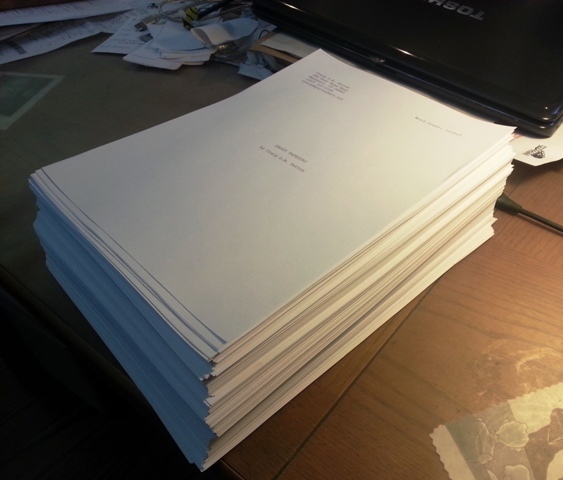
“Wait, wait, wait,” I said when I noticed panic widening the eyes of another new member. “What you’re talking about is a manuscript submission copy.”
We had a discussion on how to write a story and touched on plotting versus pantsing, writing by hand versus typing on a laptop, etc. The first point I want to make is just write the story. As Will Shetterly said, “It is better to write a bad first draft than to write no first draft at all.” I’m also fond of “Write your first draft with your heart. Re-write with your head.” There are many such encouraging quotes, but I’m sure you understand what I’m saying. Get that story written.
With that being said, the second point and true purpose of this post is to offer another resource where new writers can find the information they require to turn their manuscripts into acceptable submission copies. I’m all about giving back the information I discovered and/or processes I learned.
These steps are for formatting a novel:
- Set 1″ margins on all sides.
- Prepare a title page with your name and contact information in the upper left-hand corner of the page (some sources say include the word count here), title in ALL CAPS about one-third of the way down the page, skip a line, followed with a novel by, skip a line, and your name.
- Don’t number the title page. Begin numbering (1) with the first page of the text of the manuscript, usually the introduction, prologue, or chapter one.
- Use a header on each page, including your last name, the title of your novel in ALL CAPS, and the page number. Remember to make the font of the header match the font of your manuscript.
- Start each new chapter on its own page, one-third of the way down the page.
- The chapter number and chapter title should be in all caps, separated by two hyphens: CHAPTER 1—THE BODY.
- Begin the body of the chapter four to six lines below the chapter title.
- Indent fives spaces for each new paragraph.
- Double-space the entire text.
- Use a standard font, 12-point type. Times New Roman, Arial, or Courier is fine.
- Alignment should be to the left, not justified. The right edges will not be uniform.
- Indicate scene breaks with a blank line and five centered dashes or number signs.
- End your manuscript with the five centered dashes or number signs or simply type THE END.
- Use 20-lb. bond paper.
The guidelines for a manuscript submission copy may vary a titch based on which websites you reference and/or who you talk to. The steps presented above are the basics and will ensure that your manuscript doesn’t get rejected because it is sloppy.



 hl gibson, author