Short But Sweet Information

I love finding valuable resources for writing, but even more than finding them, I love sharing them.  One of my goals for my blog is to provide another place where fellow writers can find gems such as the two I’m featuring today.

In addition to writing novels, I churn out a short story from time to time.  Now that I have a few stacked up like firewood, I thought I might as well submit them.  Ah, but how to format a short story when I’ve been focusing on how to format entire manuscripts?  Turns out it’s not all that different, and it’s actually quite easy.

The first link I’m providing is How to Format a Short Story Manuscript for Submission: a Checklist by Joe Bunting.  Who doesn’t love a good checklist, right?  In addition to this is a wonderful visual resource called Proper Manuscript Format:  Short Story Format by William Shunn.  Mr. Shunn is brilliant when he not only tells us how to format our short fiction, but he shows us what it should look like as well.

I hope you find these helpful, and that you’ll pass on the useful information.

Baring My Writer’s Soul – Part 21

A little over a month ago, I started a new section on my blog called Quotation Station.  It began as a blog post of its own explaining the difference between a quote and a quotation.  The idea was that I’d schedule writing-related quotations for my followers to appear on Friday morning.  They were to be a friendly handshake as we parted ways for the weekend, a final communication before my family began our electronics and social media blackout for Shabbat.  Everyone seems to like them so far.

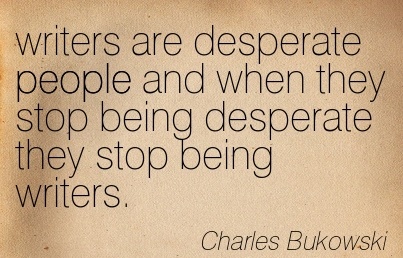
Last Friday’s post included a quotation from Charles Bukowski stating “Writers are desperate people, and when they stop being desperate, they stop being writers.”  This particular quote fit my writing life so well.  At any given moment of the day, I have felt desperate about my writing.  Desperate to complete it, desperate to come up with new things to write for my blog or a literary journal or a novel, desperate to be published, desperate, desperate, desperate.  All that desperation added up to a lot of miserable living.

What struck me as interesting was that I’m not alone in this practice and belief.  But it also made me question it especially since one of my repetitive prayers was for peace in my life.  Desperation and peace cannot cohabitate, so which did I really want?

Further adding to my desperation was something a wise friend said to me a little over a week ago.  She asked how I was, and I ended up unloading a lot of desperation on her!  Thankfully, she’s not the kind of person to regret having asked.  At the end of our conversation, she suggested that I write from my abundance.  What does that even mean?

About a week after her suggestion, another wise friend gave me a pamphlet of Weekday Morning Prayers and the Bedtime Shema.  I started reading them in the morning and evening, and what an amazing effect they’ve had on my life in just three days.  My peace increased and my desperation diminished.

But wait, my desperate writer’s mind yelled, if you’re not desperate, you’re not a writer!  Turned out desperation was a clingy companion.  However, I was really rather tired of being desperate, and I was not at all willing to surrender the peace I’ve been praying for.  Also, I could keep writing what I loved when I wanted to write it.

You’re just being lazy, my writer’s mind whispered which I instantly knew to be a lie because leading up to the conversation with both friends, things have been falling in place in my life in a wonderful way.  Not to mention that the two chapters I’m somewhat blocked on in my new novel no longer freak me out.  I’ll sit on them for a while and not add to the blockage by stressing my mind out with desperation.  I’ll trust that in good time, the right words will come to me.

What all this boils down to for me is change.  I’m not good with change especially when it’s sudden.  Not that what I was experiencing was sudden, but it could have been if I hadn’t been so resistant to changing for the better as well as admitting that it was better.  It’s better that I’m no longer running on the gerbil wheel of desperation for all the things I mentioned above.

So now I’ll explore the abundance in my life, and I’ll write from there.  I’ve discovered an abundance of talent given as a gift from God.  I’ve discovered an abundance of time which is another gift.  I have an abundance of great books by authors who I admire; I’ll follow their example.  I have an abundance of wise friends whose counsel I’ll seek when desperation desperately tries to re-enter my life/writing life.  I have an abundance of support from my husband, William, who has supplied me with great storylines, helped me work out problems in my plot, and won’t let me stop writing when I’m in the desperation dump.

I have no doubt that desperation will attempt to raise its ugly head in my life.  It’ll evolve and reappear as envy, writer’s block, or self-doubt.  Fortunately, my arsenal is well stocked with abundance.  And in case I forget that, please, dear friend, do not hesitate to remind me as you are part of the abundance in my life.

Write Happy!

Just Don’t Get a Ticket

As I was reading the other day, I came across the phrase speeded up.  By now you know my affinity for words and all things word related, so you’ll understand my reaction of sitting bolt upright.  Not only did the phrase not sound correct, I don’t believe I’ve ever seen it used that way nor have I used it myself.  Naturally, this sent me to the laptop to check in with some of my favorite grammar websites.

As it turns out, neither sped nor speeded is more correct as they are both standard variations of the verb to speed.  In many old English reference books, the rule is that speeded works only in the past tense phrasal verb speeded up such as I had read.  What I found amusing is that I usually lean toward those archaic/dated words and phrases, but obviously not in this particular instance.

Today writers use what they think sounds best.  Speeded is often used without up whereas sped is used with up or alone.  Also, sped is more common than speeded these days which, according to some sites, makes it the safer choice.  In either case, be consistent when writing.

Quotation Station


Greetings, Dear Followers!  Perhaps you’ve noticed I’ve been MIA for about two weeks.  For this I apologize and ask your forgiveness.  Things around the Gibson household were a little crazy for some time as we dealt with crashed operating systems and my neck injury.  I believe everything has been sorted out, and I shall return to amazing you with wonderful, informative blog posts.  Until then, wishing you a peaceful and productive weekend.  Shabbat Shalom!

Go For the Gold

Writing goals are one of the things I hear debated quite often among writers.  For some reason, Stephen King is always mentioned in these conversations.  Awestruck statements of, “I heard Stephen King writes a thousand words a day” always leave me a little mystified.  I think to myself That’s great if it works for StephenLord knows the man has enjoyed some success and maybe that has something to do with his daily writing goalsMaybe not.  Because if we’re saying daily word counts are directly related to the number of books published which translates into success, then Stephen King far outstrips Harper Lee.  Yet I doubt anyone would consider Harper Lee a failure.

There is a place in King’s book On Writing where he says something like you have to shovel the shit every day, meaning no matter how bad the writing is keep it up until you reach your daily word goal and edit it later.  I don’t want to shovel shit.  I’d rather mine for gold.

Why would I purposefully layer word after word, line after line of bad writing on top of something good, or worse on top of something else bad, just to say I’ve reached a daily word goal?  I wouldn’t find that at all satisfying.  Now don’t get me wrong:  my work isn’t so perfect the first time around that it doesn’t need edited.  It is, however, very close to my vision for a particular story because I took the time to think it through.

The other thing my method does for me is alleviate the pressure I feel when writer’s block stumps me.  Again, I don’t feel the need to put anything on the page just to fulfill an arbitrary number.  In doing so, I free myself to explore the rabbit trails that usually lead me to the good writing as long as I don’t force it.

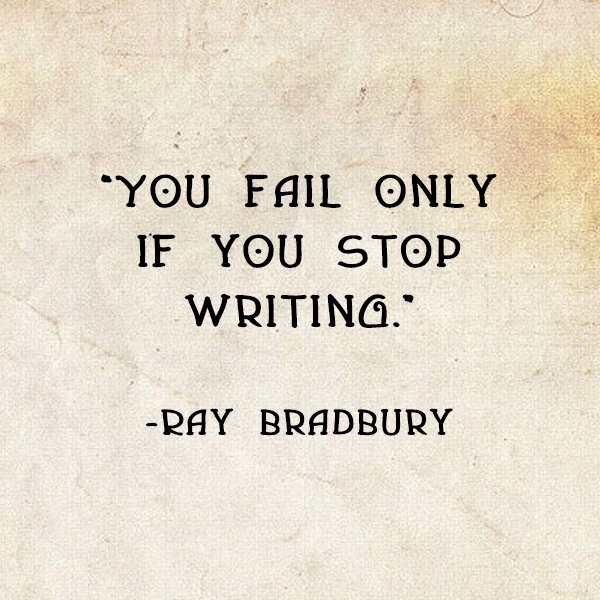
So yes, there are days when my best writing amounts to a single, brilliantly written sentence, and there are days when whole chapters are completed.  In either case, I count myself as successful because I’m more of a Ray Bradbury kind of writer when it comes to word counts:

Quote vs. Quotation

Today’s The Weight of Words came about because I was looking up the proper usage of single and double quotes and came across a debate on the words quote versus quotation.  I wish I could find the original article as the author thereof was quite adamant about not using them interchangeably.  Articles I’ve found since have been a lot more lenient but no less informative.

I’m also featuring this today because I’m using it to launch Quotation Station.  It’s been on my mind for some time as I read books and perused the Internet to share quotations I came across that struck me as intelligent, wise, funny, poignant, relevant to writing, or any combination thereof.  My goal is to feature three posts a week, but I feel as if I’m leaving my followers hanging over the weekend.  Quotation Station will be a sincere handshake as we part company from Friday to Monday to relax from the hectic week.

Per Richard Nordquist writing for ThoughtCo.:

In formal English, quotation is a noun (as in “a quotation from Shakespeare”) and quote is a verb (“She likes to quote Shakespeare”).  However, in everyday speech and informal English, quote is often treated as a shortened form of quotation.

The noun quotation refers to a group of words taken from a text or speech and repeated by someone other than the original author or speaker.

  • direct quotation is a report of the exact words of an author or speaker. Direct quotations are placed inside quotation marks.
  • An indirect quotation is a paraphrase of someone else’s words:  it reports on what a person said without using his or her exact words.  Indirect quotations are not placed inside quotation marks.

The verb quote means to repeat a group of words originally written or spoken by another person. In informal speech and writing, quote is sometimes used as a shortened form of the noun quotation.

Nordquist, Richard. “What’s the Difference Between the Words “Quotation” and “Quote”?” ThoughtCo. N.p., 03 May 2017. Web.

For examples, usage notes, and practice enjoy reading the article in its entirety here:  “What’s the Difference Between the Words “Quotation” and “Quote”?

Don’t Compound Your Problems

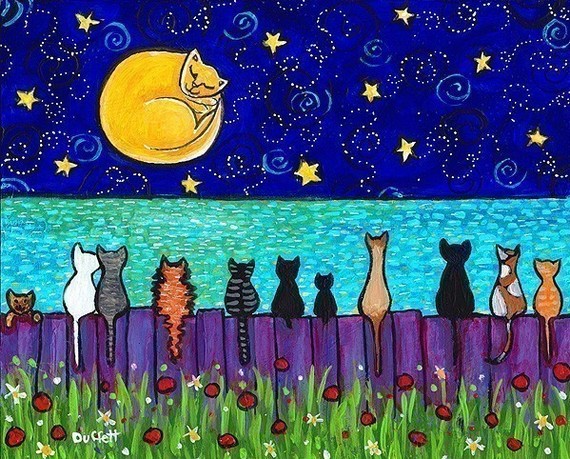
Full Moon Cats by AliceinParis (Shelagh Duffet) available on Etsy

You may not have known what it was called, so you couldn’t even Google the answer, but I’m here to tell you, friend, it is compound possession, also known as joint possession!  That’s right; it’s that tricky little scenario that makes your fingers falter across the keyboard when you’re writing about two subjects in possession of something.  Does each subject have an apostrophe and an S or does only the last subject in the group have the apostrophe and the S?

For instance:  George and Mary’s cats are always escaping.

From this sentence, we can assume that George and Mary live together and are in possession of a herd of fugitive felines.  The rest of the story would probably bear this out.  But what if George and Mary are actually neighbors in possession of separate mobs of moggies who escape for midnight sessions of group yowling on the fence between their properties?

Then the sentence would look like this:  George’s and Mary’s cats are always escaping.

Your decision will be based on whether or not the two subjects are in possession of shared items or separately owned items.  You may be saying, “Yes, but George and Mary both owned cats, and since cats are the same thing, shouldn’t it always be like the first example?”

Consider this:  George’s and Mary’s coats are in the front closet.

Clearly, George and Mary aren’t going to wear the same garment.  They own separate coats.  The same applies to their cats.  Now if George and Mary could just contain their wayward beasts, the rest of the neighborhood could sleep in peace.