I Think That I Shall Never See…

HBSmithPhotography

HBSmithPhotography

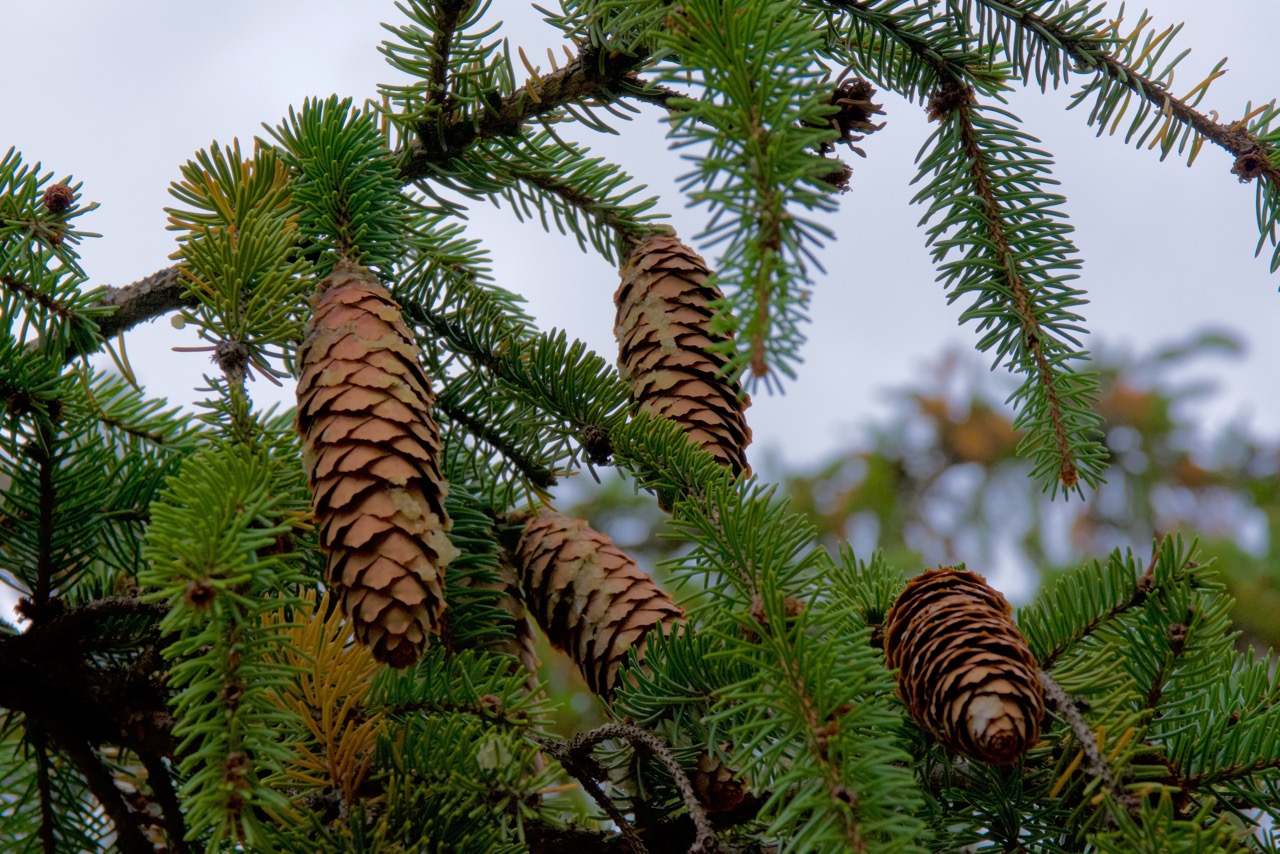
Trees are beautiful and majestic. I remember the pine tree on the back corner of our yard at the house in Ellet. There weren’t many limbs that were good for climbing, they were too close, too thin, and too gooey with pine tar, but we still managed to hoist ourselves up through the tightly spaced branches to reach a height that made the adults look up with concern. Don’t go too high was always the admonition. It never felt that high. We climbed under the illusion of childhood invincibility, a trait we didn’t even know we possessed.

That old pine was the only real tree on our property in suburban Akron. I say real because it was years before my father planted a Sunburst Honey Locust in the front yard at my mother’s request. The locust tree was so delicate and frilly, nothing like the ancient sentinel in the backyard. We would never climb Sunny. That was the name we gave to the tree.

The last time I drove past our former home, Sunny stood head and shoulders above the little white Cape Cod where I spent my grade school years. I don’t know if the pine was still there. I drove slowly past the house but didn’t linger long enough to make anyone suspicious. I really need to see if the pine still stands. As tightly packed as the cookie cutter houses were placed, removing the pine would be a precarious job best left to the professionals. Until that sad day, I hope many more small hands grasp the gritty branches, hauling little bodies skyward, as the camphorous odor of pine sap assaults little noses.

The Way I See It

window-shopping-rosita-larssonI have watched you from this window for so long that I have to wonder how often you can go on looking and never seeing. I’m right here in plain sight.

Always the same routine with you: every day searching for something that is right before your eyes, stopping to observe as crowds hustle past.

I see it in your blank face, your empty expression, the way you stare. You want something more, something to quell the dissatisfaction. But you don’t even know what that something is. Your reflection shimmers with desire as you stand there.

If only you weren’t so frozen, unable to move beyond this prison not of your own devising. You let yourself be used, positioned for everyone else’s happiness at the cost of your own. Now you’re on display for the entire world to see, all the while pretending you are invisible, hidden away on the top floor, safe above the masses below.

From every angle you are visible, from inside and out. And you don’t even know I’m watching. If you could just tip your head up or tilt it down, a bit to the left, maybe the right, you would see me there as rigid as a soldier yet at ease. Patiently waiting. And never touching, we would share a smile and know that everything will be all right.

Instead, you fix your hair, straighten your clothes, stand at perfect, stylish attention, retreat within. It’s time to move on; tomorrow, we will repeat the whole process.

~~~~~

Thank you to my dear friend, Rosita Larrson, for allowing me to use her beautiful photography as a visual writing prompt.  This particular photograph, “Window Shopping,” can be found at Rosita Larrson, fineartamerica, in the gallery titled Mannequins Display Windows Reflections.

A Vision in Red

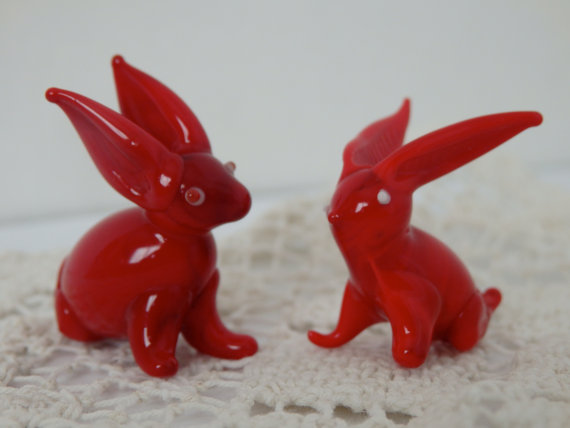
I woke up this morning thinking about the red glass rabbit. The memory must have ridden in on the tail end of a wild night of dreaming because I haven’t thought about her in decades. In my mind, she still holds center court among the animal figurines sitting on my great aunt’s kitchen windowsill in Tennessee.

My great aunt never hesitated to let me play with what I believed were her most treasured possessions. For this reason, I took great care not to break any of the inch and a half tall animals in the collective herd. There was a goose and a deer among the group, but my favorite was the solid red, blown glass rabbit with two miniscule dollops of white glass for eyes. She was perfect.

Red Glass RabbitThe red glass rabbit starred as the heroine in all my adventures played out on the kitchen table. She forever needed rescued by the other animals led by her boyfriend, the deer. I’m pretty sure I named him Bambi; I don’t recall what I named the rabbit. Every scenario, in which I imprisoned her in a tiny basket, ended with her being declared queen, a title she graciously accepted.

Occasionally, her liberation depended on the assistance of my great aunt’s salt and pepper shakers. There were four of them, two couples of different size, reminiscent of the man on the Cream of Wheat box and Aunt Jemima. These shakers are the type of item labeled Black Americana today and are found in antique stores and probably homes south of the Mason/Dixon line. I could be wrong about that, though.

During one summer visit to my great aunt’s home, I was horrified to discover that since the last year, someone had chipped the ear of the red glass rabbit. My great aunt didn’t seem as upset as I believed she should have been. She said either she, or my great uncle, or her mother probably knocked the rabbit off while washing dishes. My thoughts fluctuated between relief that it wasn’t me who caused the mar and appreciation that the damage could have been so much worse.

My great aunt broke up housekeeping several years ago after my great uncle and her mother passed. She sold the home and large items in Tennessee, bestowed smaller goods upon close friends, packed up the rest, and moved back to Ohio. It was good to have her home. I asked about the salt and pepper shakers because I trusted their size ensured they survived until my adult years. Unfortunately, my great aunt had already given them away.

I never inquired about the red glass rabbit. I knew in my heart the tiny treasure had disappeared long ago. Before I stopped playing with my own collection of animal figurines, the red glass rabbit probably had her ears and toes chipped until she appeared in a sorry state. Or perhaps one tumble into the depths of the empty kitchen sink was one too many, and she had to be discarded.

Does it matter that my great aunt probably doesn’t even remember owning such an item?  Does anyone reading this even care? Who can say? All I know is that somewhere in time, a very talented glassblower created a beautiful red glass rabbit that brought immeasurable joy to a little girl.

Quit lolliking about an’ read this!

Gladstone_Pottery_Museum_Stoke-on-Trent_450Today’s The Weight of Words blog post began as tweets between me and my brilliant, artistic friend, Michael Ferguson. Mike lives in England, and right before the holidays, he came across the word crimbo in his tweet. I had a pretty good idea of what the word meant, but it generated a LOL and the request for an explanation.

This prompted Mike to go all ar ter toke crate on me (I still have no idea what this means!) and provide a link that would help me decipher what he was saying. At least in theory the link was to have done this.

Since The Weight of Words, Writing Toolbox, and Research Road are all present to assist other writers in need, I thought the link Mike sent would prove most helpful to anyone wishing to write in the language of the Potteries, a North Staffordshire Dialect.

As I scrolled through the list, I was quite pleasantly surprised to find that I recognized several words and phrases because I have heard them employed throughout my lifetime. I always believed them to be West Virginia-isms, but now I’m curious as to how these odd turns of phrase ended up in the mouths of my Mountain State ancestors when they have been credited to Stoke-on-Trent, England, and not Camden-on-Gauley, West Virginia.

Perhaps we shall never know…

Goodnight, Irene. Have a Good Night.

soiree1Today’s The Weight of Words blog post tackles the tricky question of whether you meant to write goodnight or good night.

Picture yourself enjoying a night out on the town that has, unfortunately, come to a thrilling but exhausting end. Your friends have graciously delivered your slightly intoxicated self to your doorstep, and you send them off with kind words. At this precise moment, you experience brief clarity and decide that you must rush to your laptop to chronicle the exciting evening including your final farewell.

If, in your parting statement, you meant to convey “Have a good night,” then you would type it as two words, good night.

However, if your last comment was a benevolent wish upon your friends, you would type goodnight.

Confusing? Not really. Just keep in mind that the first is an abbreviated form of “Have a good night” and the second is a pleasant wish bestowed.

Drowning Your Sorrows In Cinnamon

Drowning Your Sorrows In Cinnamon 2John Welles and his two best friends, Sam Feldman and Claude Willoughby, formed a strong bond during their two years of pre-med studies at the University of Maryland. As they faced the upcoming challenge of pursuing the heart of their degree, the three young men fluctuated between excitement and anxiety. Yet their biggest concern wasn’t that they would perform poorly in their classes and labs or receive low grades. What sent the trio into a case of the doldrums was the worry that they would lose touch as their classes intensified in difficulty.

John’s Aunt Prudence suggested an end-of-summer barbeque to lift the boys’ spirits, but her sassy cook, Lucia, responded with a more immediate remedy: cinnamon cake. Lucia knew the benefit of comfort food, and the cake she served the boys was rich and delicious enough to drown anyone’s sorrows.

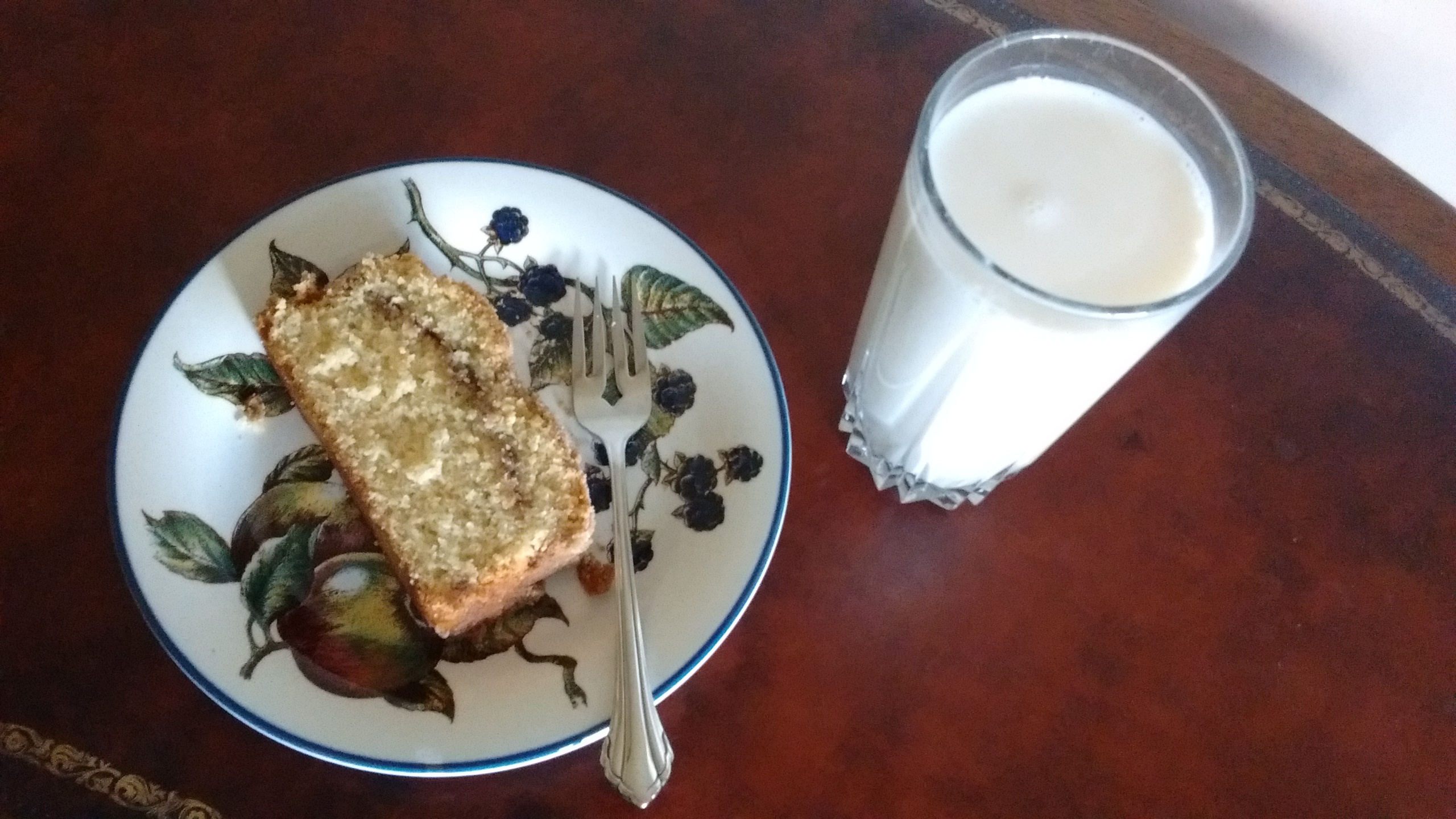
The following recipe is the one I had in mind when I wrote this scene. The flavor is reminiscent of pound cake, but this golden confection is lighter in body and smooth in texture. Be warned: it is rich beyond belief; however, most of the sweetness comes from the cinnamon streusel layer.

Enjoy a slice of Lucia’s cake with a cup of coffee or tea or a glass of milk.

Lucia’s Cinnamon Cake

Cinnamon Streusel Topping

½ c flour

½ c packed brown sugar

1 t cinnamon

¼ t salt

¼ c unsalted butter, cold & diced

Mix the flour, brown sugar, cinnamon, and salt in a bowl. Work in the butter with the dry ingredients using your fingers or a pastry blender until coarse crumbles form. Set aside.

Cake Batter

Preheat oven to 350° and grease and flour a metal 9 x 5 x 3 inch baking pan.

I strongly recommend using a stand mixer for this cake. The thick batter closely resembles dough and has the tendency to climb the beaters of a handheld mixer.

½ c unsalted butter, softened

1 c sugar (I use raw)

2 ¼ c cake flour OR all-purpose flour sifted with 1 T cornstarch per cup

2 t baking powder

¾ t salt

5 egg yolks

¾ c whole milk

1 t vanilla

Cream the softened butter and sugar. Add flour, baking powder, salt, egg yolks, vanilla, and milk. Mix on medium low speed until thoroughly combined, approximately 3 minutes. Spread 1/3 of the batter evenly in the baking pan. Top with half of the cinnamon mixture. Spread the remaining 2/3 of the batter in the pan and top with the rest of the cinnamon mixture.

Bake on the center rack for 65 minutes or until a tester inserted in the middle comes out clean. Cool the cake until you can handle the pan before turning it out.

Enjoy!

Completely Sauced

IMG_20151123_095305152Breaking bad news is never easy. Receiving bad news isn’t much better. The only hope is that it doesn’t affect you directly, but even then, you may be called upon to share the grief and comfort those who need it. But what do you do when the bad news is disguised as a lovely dinner with your friends and slips out through the course of pleasant conversation? Factor in the knowledge that the bad news is tiptoeing dangerously close to your own awful experiences, and the situation is bound to go south. Such was the case for Dr. John Welles when he accepted an invitation to dine with Reuben and Hannah Wise.

What began as an enjoyable meal with people he knew for years turned out to be a hidden request for assistance with a task that John absolutely does not want to complete. Not even Hannah’s delicious cooking could persuade the doctor to go against his conscience or dredge up painful secrets. By the time the Wises and Dr. Welles parted, not even the sweetness of Hannah’s homemade applesauce could soothe hurt feelings or smooth over the rift between them.

The following recipe is the one I had in mind when I wrote the above-mentioned scene. As with many recipes, there is room for change based on your preferences. I find that applesauce, not unlike apple pie, is one of those recipes that bear the signature flavors usually handed down through the family. I hope you enjoy the way my family makes it.

Homemade Applesauce

My favorite apples to use are Cortland, Jonagold, Melrose, Idared, Winesap, and Golden Delicious, and I use a combination of all six in this recipe. Stotler’s Orchard is where I purchased apples for saucing.

½ c brown sugar

1 t vanilla

1 t cinnamon

Allspice to taste***

1 c apple cider

I prefer to use a 6.5–quart cast iron, enamel covered Dutch oven, but any heavy cooker will do.

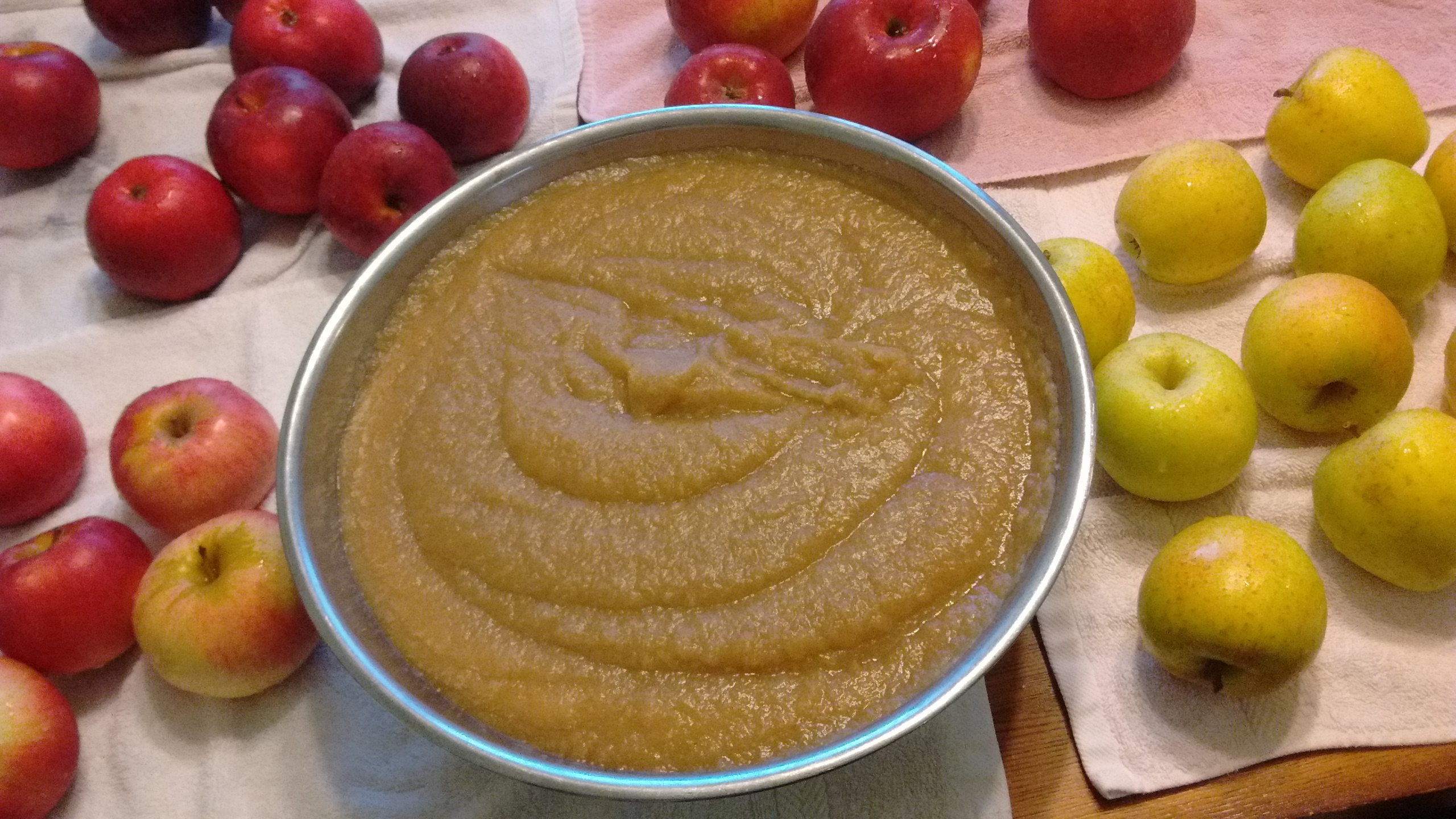
Peel, core, and cut enough apples into one-inch chunks to fill the cooker, leaving a little room to stir. Add the apple cider, brown sugar, vanilla, cinnamon, and several hearty dashes of allspice to the apples. Stir all ingredients, cover, and cook on a medium high heat. Don’t let the apples boil. Check regularly and stir the apples up from the bottom so the mixture cooks evenly.

At about 30 minutes, the apples should be soft enough to cut through a chunk with the side of a wooden spoon. If not, cook for an additional five minutes and recheck.

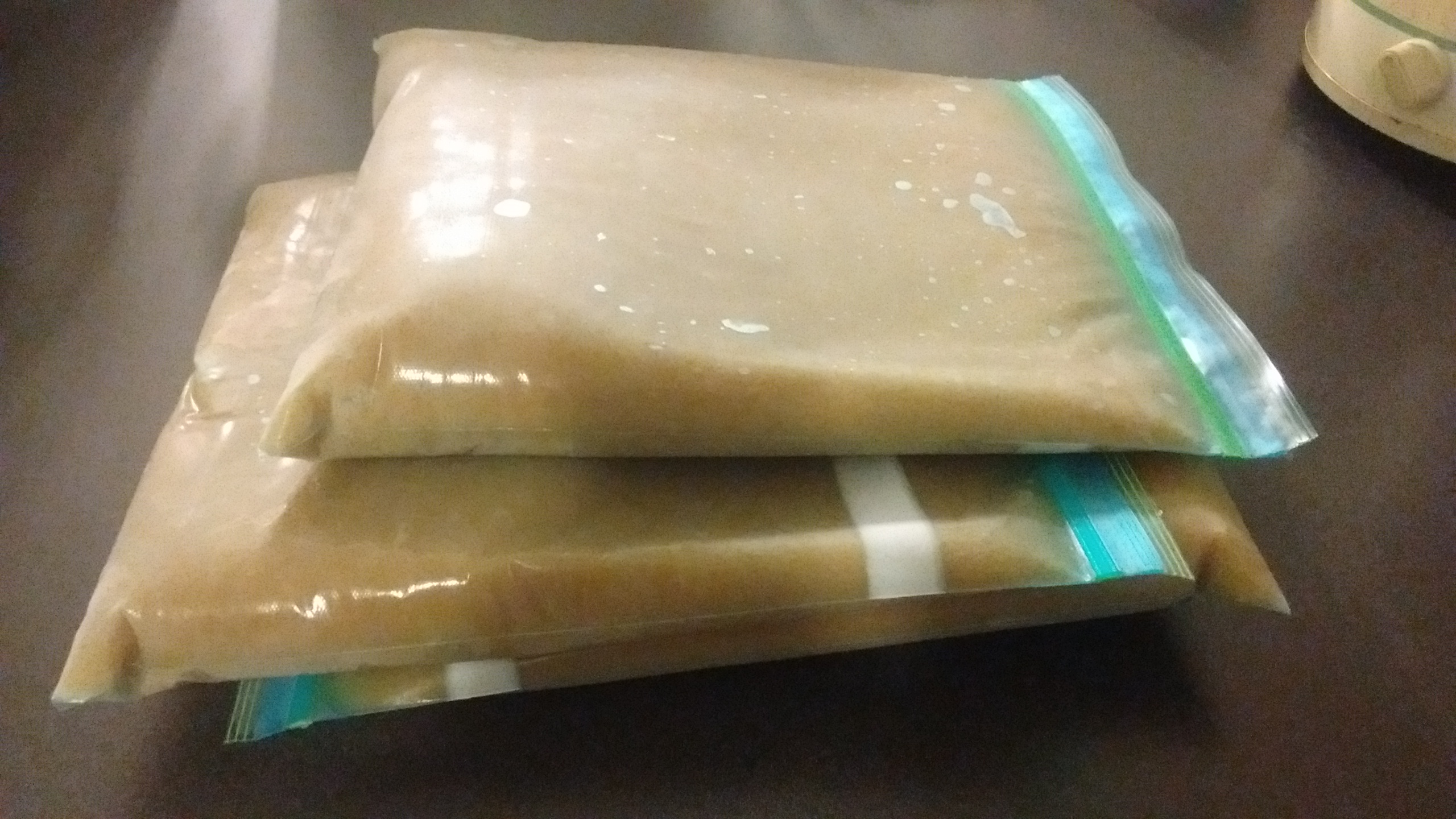
Once the apples are tender, transfer small batches to a food processor and blend to desired consistency. I allow the applesauce to cool to room temperature in a large metal bowl before transferring it to gallon-sized freezer bags. Enough applesauce is ladled into the bag so that it is about a half inch thick when sealed and laying on its side. Full bags stack nicely in the freezer.

IMG_20151227_162102649

***If your allspice lists several other spices in the ingredients, you’re not using real allspice.

What’s On the Menu?

What's On the MenuHow many times have you been writing brilliantly without pause only to stumble over the correct spelling of the word hors d’ouevre? I have to check every time I use it. This time, however, it was pad thai that sent me to the Internet not so much for a spell check but to verify whether or not the ‘T’ in thai was capitalized.

My search led me to UC Style: How to capitalize, spell, punctuate food, culinary terms, where I found the answer to the pad thai question. This is perfect for an author who loves to feed her characters (Edible Fiction). I’m definitely stocking my Writing Toolbox with this important contribution to The Weight of Words.

I hope you will find this site as helpful as I did.

Bon appetite!

The Sweet Side of Bitter

The Sweet Side of Bitter 3John Welles and his two best friends, Sam Feldman and Claude Willoughby, formed a strong friendship during their two years of pre-med studies. By 1927, when they began studying medicine in earnest, they were inseparable despite the differences in their personalities. It was their closeness that allowed John to pick up on the problems with Claude’s family life that his friend tried to keep hidden. After the boys naively crossed the line by interfering with Claude’s father’s private business, the once subtle problems exploded to the surface. John felt powerless to help Claude.

Worsening the issue was J.D. Willoughby, Claude’s Father, who infuriated John by maintaining a polished veneer on the situation in an effort to keep up appearances. J.D. Willoughby was the type of man who didn’t even flinch when he realized John and Sam overheard him yelling threats at Claude. Instead, he ushered Claude’s friends to the kitchen, treating them like ignorant children and distracting them with freshly baked cinnamon rolls.
The Sweet Side of Bitter 2

The following recipe is the one I had in mind when I wrote the above-mentioned scene. The sinfully rich, delicious baked good is a cut above a regular cinnamon roll with the inclusion of bourbon, golden raisins, and Zante currants; it’s just the sort of dessert J.D. Willoughby would expect to be served in his home. They are so luscious, I hesitated to attach them to such a despicable character. I trust J.D’s reputation won’t negatively influence your opinion of the recipe.

Enjoy!

Willoughby Family Recipe for Cinnamon Rolls

Dough:

2 ¼ t yeast (1 – ¼ oz. package)

½ c warm water (110° – 120° F)

½ c scalded milk

¼ c sugar (I used raw)

⅓ c unsalted butter, melted

1 t sea salt

1 egg

1 t pure vanilla extract

3 ½ – 4 c flour

Filling:

½ c unsalted butter, melted

¾ c sugar (I used raw)

2 T cinnamon

2 T bourbon

1 t vanilla

¼ c golden raisins

¼ c Zante currants

½ c finely chopped walnuts

Butter and sugar to prepare a 9 X 13 baking dish

Glaze:

4 T unsalted butter, melted

2 c powdered sugar

1 t vanilla

3 – 6 T freshly squeezed and strained orange juice

1 t orange zest
The Sweet Side of Bitter

In a small glass bowl, dissolve the yeast in warm water and set aside. In a large mixing bowl, combine the scalded milk, sugar, melted butter, salt, vanilla, and egg. Add two cups of flour and mix until it is smooth. Add the yeast/water mixture. Add another 1 ½ cups of flour until the dough is easy to handle. Knead the dough on a lightly floured surface for 5 – 10 minutes. This is where you may need to add the additional ½ c of flour a little at a time as you knead. The dough should not be overly sticky on your hands. Place in a large, well-greased bowl and cover loosely with plastic wrap. Let it rise until doubled in size, approximately 1 to 1 ½ hours.

Place the golden raisins, Zante currants, bourbon, and vanilla in a small glass bowl. Toss the fruit to coat with the liquid, cover, and set aside.

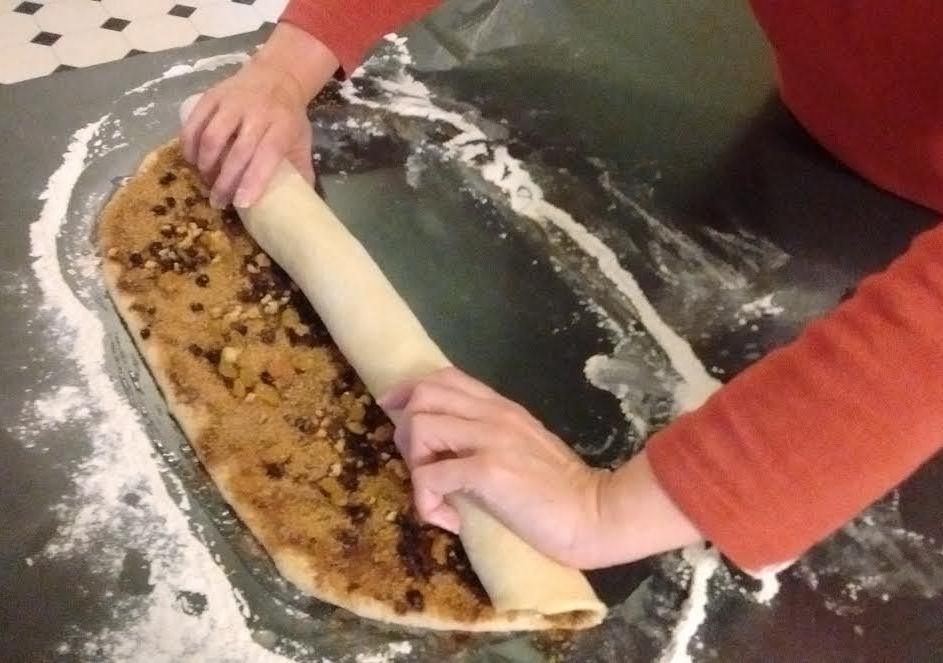
When the dough has doubled in size, punch it down and roll it out on a floured surface into a 15 X 10-inch rectangle. Spread half of the melted butter on the surface of the dough. Mix the sugar and cinnamon and sprinkle over the buttered dough. Sprinkle the raisin/currant/bourbon mixture and any remaining liquid over the dough. Sprinkle the walnuts over the dough. Begin with the 15-inch side and roll up the dough. Seal the long edge by pinching shut. Prepare a 9 X 13-inch baking dish by buttering the bottom and sprinkling it with sugar until coated. Cut the rolled up dough into 12 slices and place evenly in the buttered/sugared baking dish spiraled side up. Brush the sides and tops of the slices with the remaining melted butter. Let rise until double, approximately 45 minutes.

Preheat the oven to 350° F. Bake the rolls for 30 minutes or until nicely browned. While the rolls are cooling, mix the melted butter, vanilla, orange zest, and powdered sugar with 3 T of orange juice. Stir until smooth, adding 1 T of juice at a time until the desired consistency is achieved. Drizzle the glaze over the slightly warm rolls.

Serve immediately. These reheat well in the microwave for 10 – 15 seconds.
Baring My Writer’s Soul – Part 12

Writer's Soul 12Today’s Writer’s Soul blog post is going to be a bit like tap dancing on a landmine.  Per the suggestion in Page After Page, I’m going to explore my parent’s influence on my writing life. When I first read the exercise, I thought to myself, “There isn’t enough red wine in the entire world to make me do this, especially when both parents follow my blog.” Yet here we are.

I don’t believe either of my parents ever aspired to be writers, although I do remember mom jotting down an occasional poem during my childhood. That’s okay because neither resisted the idea of writing or being an artist of any kind.

The funny thing is I don’t really consider either of them to be readers. Well, not on the same level that I hoard and consume books anyway. Mom admits that she came to pleasure reading as an adult when she read The Wind in the Willows. This still surprises me because she was always reading to me and my brother when we were little. In fact, I credit Mom with instilling in me a love for books as I mentioned before.  (My Love Affair With Books)

I only remember my Dad reading Garrison Keillor’s Lake Wobegon Days and John Irving’s The World According to Garp. Otherwise, my only memories of Dad reading were the gigantic manuals and/or books he studied when testing to make rank on the police force.

To what degree did my parents influence my writing? Mom is extremely creative in areas of decorating, cooking, hosting, and crafting. Perhaps I’m drawing on these genes when I write. From Dad I learned that whatever I do should be done well and completed. I mention the completion aspect because he has always complained that Mom has thousands of dollars of unfinished crafts and too many tea sets. I think Dad doesn’t understand that creativity is ongoing.

Both of my parents are hard workers, and while Dad would probably say that he did what he wanted to in life, Mom would wistfully admit that there were things she would have liked to have done and didn’t. I know she wanted to own a bed and breakfast or tearoom.  Her dreaming is what prompts me to keep writing even when things seem hopeless and the self-doubts arise. Dad’s successful career causes me to worry about making money at writing. I believe this stems from the fact that he conveyed to me and my brother the need to get jobs that supported ourselves but didn’t necessarily allow us to follow our dreams. This is the type of influence one would expect from a provider.

With these perspectives on working and following dreams in mind, I am better able to understand why I vacillate between the thoughts of “Will I make any money at this or am I just chasing a pipe dream” and “I really want to write and be published more than any other creative endeavor.” There’s a lot of pressure that comes with such thoughts, but as an adult, I’ll own them.

If Mom and Dad aren’t the driving force behind my writing, who is? The first people to come to mind are the countless writers behind the Little Golden Books Mom bought for me. Laura Ingalls Wilder, Judy Blume, and L.M. Montgomery float to the surface of my memory. I could go on forever listing all of the authors and books I discovered through the years, but I’ll just say that my love of writing was birthed from my love of reading an excellent story.

What makes a great story? Great words. I admit, I’ve been caught reading with my lips moving, but if people would step closer and lean in, they would hear me reading softly to myself. When a passage is well written, it begs to be read aloud. My friend, Eleni Byrnes, would understand my obsession with words. She keeps a notebook of words she likes as she comes across them. It’s why she writes so well.

So, I’ll start with Eleni in my writing family tree and make her a sister. I’ll add Billie Letts and Wally Lamb as grandparents because they are excellent story tellers, and I’m all about the story. Isabel Allende will be my exotic aunt, and David Mitchell and David Liss my quirky cousins. Tim Gautreaux and Charles Frazier are favorite uncles.

Again, there are too many brilliant authors who have influenced my writing, so I’ll direct you to my Authors I Admire board on Pinterest and Goodreads to see who they are. Together, they make up my writing family tree and neighborhood.

I encourage everyone to explore who influences their writing or chosen art form. You’ll discover an extended family you never even knew you had.

Write Happy!