The Terror of Querying

The Terror of Querying

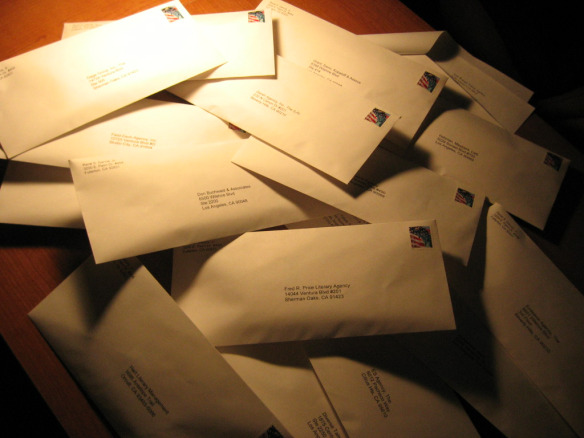
I don’t know about you, but the idea of querying an agent terrifies me. I have two opinions of this process based on various articles I’ve read.

One: As long as Starbuck’s doesn’t mess up the coffee order for the assistant to your chosen agent, your manuscript might have a chance of landing in said agent’s hands.

Translation: As long as everyone is having a good day, your manuscript might be smiled upon.

Two: Agents are fearsome gatekeepers to the world of fulfilled dreams, and I’m standing outside the gate.

That one is pretty clear.

Today I’m stocking my Writing Toolbox with a blog post from Writers in the Storm guest blogger, Julie Glover. Her post, “Are You Ready to Query,” posed questions to me that I hadn’t seriously considered before. What I had been doing is letting the answers jumble around my brain without pinning them down because I felt foolish about them. Now I think I may have been on to something.

Admittedly, I need to perfect my answer to question number one. Yes, I know what my story is about, but do I communicate that well?

To questions number two and three, I have a combined answer. I used to play a game where I fantasized about what critics would say regarding my brilliant novel. It went something like this:

If Wally Lamb and Billie Letts had a child and Isabelle Allende was her nanny, that author would be HL Gibson.

Grandiose, isn’t it? And yet, I believe this game answers the questions about writing voice and comparative titles. I consider the above-mentioned authors to be some of the best storytellers on Earth, and this is the role I want to achieve with my writing. So now I have published authors and titles to which I can compare myself and my novel.

As for voice, it’s all about the storytelling for me. My style is easy and familiar. It reads like the voice of an older relative relating family tales and history, the stories you grew up listening to at every family get together, and the ones you now find yourself telling the next generation.

As for question four, I have feedback from several beta readers, and I have completed two rounds of edits. There are beta readers waiting in the wings to assist me after I complete round three edits. A daunting process for sure, but after reading Ms. Glover’s post, I’m encouraged that I’m on the right track.

Writing Inspiration

This morning, I seriously entertained the thought of chucking it all and applying at the local grocery store.  This writing/author thing is hard.  The thought of disconnecting from social media, abandoning my author platform and potential audience, and leaving behind the fear that comes from staring at a blinking cursor on a blank page sounded wonderful to me.  I realized I needed more encouragement than Mom or my husband telling me I could do it.

Thank you Anne Leigh Parrish for coming to the rescue.  What it Takes to be a Writer was the kick in the pants I needed to go on.  Mrs. Parrish didn’t candy coat the fact that writing is hard.  Instead, she offered ways to overcome the nagging doubts.

In the same vein of thought, I would direct you to Neil Gaiman’s speech Make Good Art.  I usually think of art as a painting or sculpture in a museum or gallery, but I needed to change my perspective about that.  Anything we have created, including writing, is art.  No matter how long it takes or how many times we mess up, keeping pressing forward.

Enjoy!

Tackling Chapter Breaks

Ah, the chapter breaks. How do we write them in such a way as to keep the reader hooked? Admittedly, I like a cliff hanger as long as it doesn’t come across like the Friday episode of a soap opera.

The advice in 4 Ideas for Ending Book Chapters So Readers Will Kill to Know What Happens Next is another helpful tool for my writing toolbox. Not surprisingly, it’s by K.M. Weiland. The four ideas presented in her post are subtle changes intended to keep the reader desiring more without the cheesy cliffhanger effect.

Enjoy!

To NaNoWriMo, or not to NaNoWriMo, that is the question

I first heard about NaNoWriMo two years ago from my friend who heads our Writer’s Group. The idea of writing 50,000 words (an entire novel) in thirty days was both exciting and terrifying. As luck would have it, I had been kicking around an idea for a great novel. NaNoWriMo seemed like a good way to get the story out of my head and onto paper.

Before NaNoWriMo, I wrote short stories and children’s stories of picture book length. I had never heard of outlining a novel which might have been helpful for my first NaNoWriMo experience. Undaunted, I began writing near the end of the book leading up to the scene that was the catalyst for the whole novel. That’s when I realized I needed to go back to my character’s beginning. My first experience with NaNoWriMo was a jumbled mess.

I reached my goal of 50,000 words but didn’t have a complete novel. There was more to the story than I originally thought. The rest of the year was spent creating those portions while editing and chucking large sections of what I wrote for NaNoWriMo. I began to wonder if my November efforts had all been for naught when NaNoWriMo rolled around again. What to do?

I cheated again. I used the 50,000-word goal to keep writing new stuff my novel needed and editing what I had written last year. Perhaps the Deities of NaNoWriMo would smack my fingers with a ruler for this, but I justify what I did with the explanation that at least I wrote.

This year marks the third NaNoWriMo since I first participated. I didn’t join. I also didn’t use it as a motivational tool for rewrites and editing. I let myself off the hook with the understanding that my schedule and novel were in different places than what NaNoWriMo required. In short, I didn’t have the time and there wasn’t anything new to write or edit to meet the word count. I also didn’t want to start another novel when I already had one under way.  I’m not sorry for having tried NaNoWriMo, and I’ll probably do it again. In the meantime, I shall continue working on my second round of editing and looking for beta readers.

If you’re trying to decide whether or not NaNoWriMo is for you, consider the following article by Christopher Shultz. He’s much more eloquent in his explanation of what one needs to consider before jumping feet first into NaNoWriMo without knowing what it’s all about. I agree with his opinion that one should make NaNoWriMo work for him/her and that it isn’t a ‘must’ or ‘mustn’t’ situation in the life of a writer.

Blood-Red Pencil: Things That Drive An Editor Crazy

Today’s advice comes from The Blood-Red Pencil, a weblog hosted by a team of editors.  The post I’m sharing was written specifically by Maryann Miller, author and freelance editor.  Her post originally ran October 7, 2008.  I know you’ll find her advice is every bit as relevant today.  Enjoy! 

Blood-Red Pencil: Things That Drive An Editor Crazy.

Are You a Pantser?

There is much debate on which way to write a novel: Outline/Plot vs. Pantsing. Those who fall on one side or the other can provide plenty of evidence to support their chosen method of writing that shows why their way is best. So far, I’ve never seen the conversation turn into an argument. The discussion usually ends with one side giving the other a sideways, narrow-eyed, head-tipping look of pity for not seeing the error of their ways. It’s actually quite funny.

I find this debate always surfaces shortly before NaNoWriMo starts. Janalyn Voigt of Live Write Breathe offers advice for those who might consider giving pantsing a try. In my opinion, the points mentioned are only the beginning of pantsing. Since it’s not a formal writing style, I can’t imagine too many rules actually exist. Admittedly, I’ll be looking for them. Guidelines, however, probably abound.

I believe I fall closer to the pantsing end of the writing spectrum but well short of insisting it is the only way to write. I’m not against outlining, but like most things in my life, I never limit myself to one of anything. I have outlined scenes for my novels to use during the editing process and when research needed to be conducted. Otherwise, I write by the seat of my pants.

So, whether you outline/plot or pants it, I hope you enjoy Mrs. Voigt’s suggestions from her blog post Pantsing: Writing by the Seat of Your Pants.

  1. Quiet your inner editor. Without stopping to edit, you’ll complete your manuscript more quickly. Speed is important because you’ll be carrying a lot of details in your head. The longer it takes you to write the story, the harder it will be to remember them all.
  1. Write in marathons. Rather than writing at a steady pace, clearing as much uninterrupted time as possible facilitates your writing the first draft quickly. This prevents the disruption to your focus that even a small interruption can bring.
  1. Don’t let the story go cold. Sometimes you can’t avoid being called away to work on other projects, but afterwards it can be very difficult to pick up the story thread.
  1. Try to have at least some research done in advance. You probably won’t know everything you’ll need to research at this point, but the need to stop and research can throw off a writing sprint. Guarding against that happening as much as possible is a good idea.
  1. Don’t stop for research that won’t determine the plot direction. Only stop to research vital information. Bold print passages you need to check and do the research on the second pass.
  1. When you get stuck, skip to the next scene, if possible. Mark the uncompleted scene or passage to fix in your second pass.
  1. Jot things to fix on a notepad or on the first page of the manuscript. Write a quick reminder of what needs fixing while you’re immersed in the creative process and you’ll thank yourself during the editing process.


The Boxes in Which We Put Ourselves

The Writer Has the Last Word

The Writer Has the Last Word

It is my very great pleasure to share an article by Mela Saylor of The Greater Canton Writers’ Guild, Inc.  The following article was featured in the September newsletter.  Information regarding the Guild can be found at:  http://cantonwritersguild.org/

Mrs. Saylor’s personal blog can be found at:  http://paintandpens.blogspot.com/

The Boxes in Which We Put Ourselves ~ Mela Saylor

First time writers are always told “write what you know” and they dive into their pool of knowledge head first, taking their first tentative strokes with their pens. But after a few years and many laps of swimming in that subject matter, writers may feel the need to expand. To be brave, writers must get out of the pool and take a dive into the ocean.

Explore new topics, learn new things. 

The world of writing is vast, and I find that exciting – and there’s no need to stay on the same topic all the time. To be honest, your readers might be bored hearing the same topic all the time. Understandably, writers may discover they have a tendency to stay within certain comfort zones. But it is always good to step out of what we so often find ourselves writing. Learn something new and play with ideas – push them around, see how far they’ll stretch. We do need to keep in mind that there is a difference between having a recurrent theme and redundancy.

Writers may wish to ask themselves what they have learned as a writer this past year – your writing needs to grow right along with you. If your writing doesn’t grow, if it stays the same, it becomes stale. Make a promise to yourself to take a chance or two with your writing style and subject matter, explore and reach out into new horizons. Starting something new – topic, idea or story line – is exciting and keeping to what you’ve done before is limiting. Take a chance. Who knows where you’ll go.

Literacy and Democracy

Reading and writing, like everything else, improve with practice. And, of course, if there are no young readers and writers, there will shortly be no older ones. Literacy will be dead, and democracy—which many believe goes hand in hand with it—will be dead as well. ~Margaret Atwood

Since I began working at the library, I have seen a decline in the quality of books for children and teenagers.  I have even witnessed a decline in the value of those being read by adults, and it shocks me.  There is very little worth in the written word lately.

My concern is that authors aren’t putting out their best work for the sake of their readers.  I find it hard to believe that some writers are actually proud of what they are producing.  Rather, it seems as if turning a quick buck is the goal.  Again, this is cause for concern.

As a writer, I lay this burden at my own feet first.  My goal is to write a book that will engage my potential audience.  I dream about my novel becoming a classic, but, at the very least, I want to give readers something to chew on mentally.  Even if I create a book that’s just a good story, I work to make sure it’s well written.

What we feed our minds is as important as what we feed our bodies.  I’ll admit that I love a good dessert as much as the next person.  However, even desserts come in varying degrees of quality.  Then again, so does much of what we eat to sustain ourselves.  What I mean is, a diet of garbage from fast food restaurants isn’t going to provide what our bodies need.  I could probably live a better life eating my mother’s homemade desserts all the time, not that I would.

The same is true with what we choose to read.  I can’t fill my mind with endless garbage and expect to increase my knowledge and/or awareness of the world around me.  Too much cotton candy for the brain will render me useless.  I’ll die without anything of value to read.  This is the point where someone will want to debate who assigns value to what is being written and read.

But just for a moment, let’s be logical.  A steady stream of unintelligent reading is harmful.  Like cotton candy, it’s fun for the moment, but it won’t sustain you.  Train your brain to crave the weightier reads the way you teach your body to desire healthy food.  I promise you, there are no negative side effects to nourishing your mind.

As for the link to democracy, even if someone lies to you about a situation, you will know better because you took the time to read and find out.  You will not be led around by the nose.  You’ll be mentally strong enough to meet their attempted deception head on.  You will understand what is being said to you.  What’s more, you’ll be prepared to fight back.

So I implore you:  seek out quality reading.  Treasure it and share it with the upcoming generations.  Write the very best you have to offer.  By providing worthy literature, poetry, screenplays, etc., you will leave a foundation for the youth.  In return, they will know how to take care of you in your golden years as well as prepare for the generation coming up under them.

Dripping Ink – Questions for Self-critique

The Writer Has the Last Word

It is my very great pleasure to share an article by Caroline Totten of The Greater Canton Writers’ Guild, Inc.  The following article was featured in the September newsletter.  Information regarding the Guild can be found at:  http://cantonwritersguild.org/

Dripping Ink by Caroline Totten

Questions for Self-critique

Do your demons imitate the gods by grabbing and holding attention? (Your demons are ideas that keep poking you in the eye. If the idea arouses laughter, tears, paranoia, fright, curiosity or indignation, etc., you have acquired a point of view, which may boil into a plot.)

Does the plot offer an opportunity to provide fresh insight into the theme? (Ideally, the plot begins with a distress signal in the middle of the story. The action is already in progress and tinged with an emotional element in the main character. Usually, the setting fits the character and supports the viewpoint.)

Is the character(s) consistent in the context of the plot? (Draw the emotional tone from your personal experience and place it in the persona of the protagonist, the main character. The conflict may be psychological, physical, or ideological, or a combination of these elements.)

Here are a few aspects of the reader/author relationship to keep in mind. By being a writer, or hoping to become one, your entire self becomes an instrument to observe and record human experience. When you extrapolate heartache, joy, fear, whatever, and put them into your character, you are actually putting the reader in touch with his emotions. (Numbness, repression, or suppression are emotional factors.)

Psychologically, mystery, or suspense stories excite the mind of the reader.

Horror stories, by a circuitous route, help the reader release his fear.

Adventure stories encourage bravery.

Love stories release hormones that tenderize the heart.

Fantasy encourages imagination by offering another way of perceiving the resolution of conflict even though at the outset, the reader may be looking for escape.

Humor may release attitudes that might otherwise be socially rude or crude.

Actually, stories that contain violence, corruption, and greed may contribute to the reduction of these elements and/or act as a catharsis for the reader.

Reading fiction is not an idle past time. Its factual component may differ from nonfiction, but the result is similar. The point of view alters the reader’s perceptions.   Effective writing heightens awareness of the subject by allowing the reader to participate in the physical and mental experience of the character. Most effective stories show the character in action. In some cases, “thinking” by the character rather than dialogue or confrontation may be the entrance into a story. The approach depends on the genre, your style, and editorial desires. (At times, magazine and book editors don’t know what they want until they see it.)