I’ve spent the week working on my current work in progress, but now it’s time to relax. Shabbat Shalom to all my followers. May your weekend be peaceful and productive.
I’ve spent the week working on my current work in progress, but now it’s time to relax. Shabbat Shalom to all my followers. May your weekend be peaceful and productive.

Shabbat Shalom to all the creative souls! Your time is now.

 I am seriously considering the switch to disposable plastic cups. I originally wanted to do this because both of the men in my house, husband and son, are notorious for grabbing a clean glass when they have one right in front of them. The amount of dirty dishes they produce in a day is staggering, but at the forefront of the parade of crockery and glassware marching into my dishwasher is always the humble tumbler.
They recently earned a reprieve in my campaign to get them to reuse a glass when illness took America in its grip. Just today I logged on Facebook to see that several more friends were either succumbing to the creeping crud or finally recovering from it. Because I am somewhat of a germaphobe, I granted husband and son amnesty during the periods of sickness that took down the Gibson Household not once, not twice, but three times.
But my men, God bless them, aren’t always diligent in following my gently applied guidelines when it comes to glasses. For example, I love to keep a glass by the sink full of ice cubes and fresh water so I can grab a drink whenever I’m thirsty. We don’t own one of those fancy refrigerators with water and ice magically spewing from the door, so this practice served me well until my son decided to indulge himself in my thirst quenching drink. I cannot tell you how many times the water-thieving twerp has guzzled my beverage moments before I reached for it. Adding insult to injury, he left the empty glass full of ice cubes right where I placed it.
Husband, on the other hand, is actually quite good about not drinking from my glass except that he forgets which glass is his and exactly where he set it. His mistake results in another lecture on the evils of the “community glass” replete with examples of how drinking from someone else’s glass is just plain gross.
“Guys, my glass is the one with the pebbled texture on the inside, okay?”
“Oh, I drank out of that one,” says the son who came home from school with the sniffles.
Big sigh as I empty that glass and place it in the dishwasher. Then I fill another glass, this time one with a lovely pattern resembling tartan plaid cut into the glass, and fill it with ice and water for me and me alone. Except this is also the pattern of the glass husband, who is recovering from illness, has decided upon, and now he can’t remember where he set his glass, and maybe he drank out of mine, maybe not. Two more glasses enter the dishwasher to prevent the spread of germs.
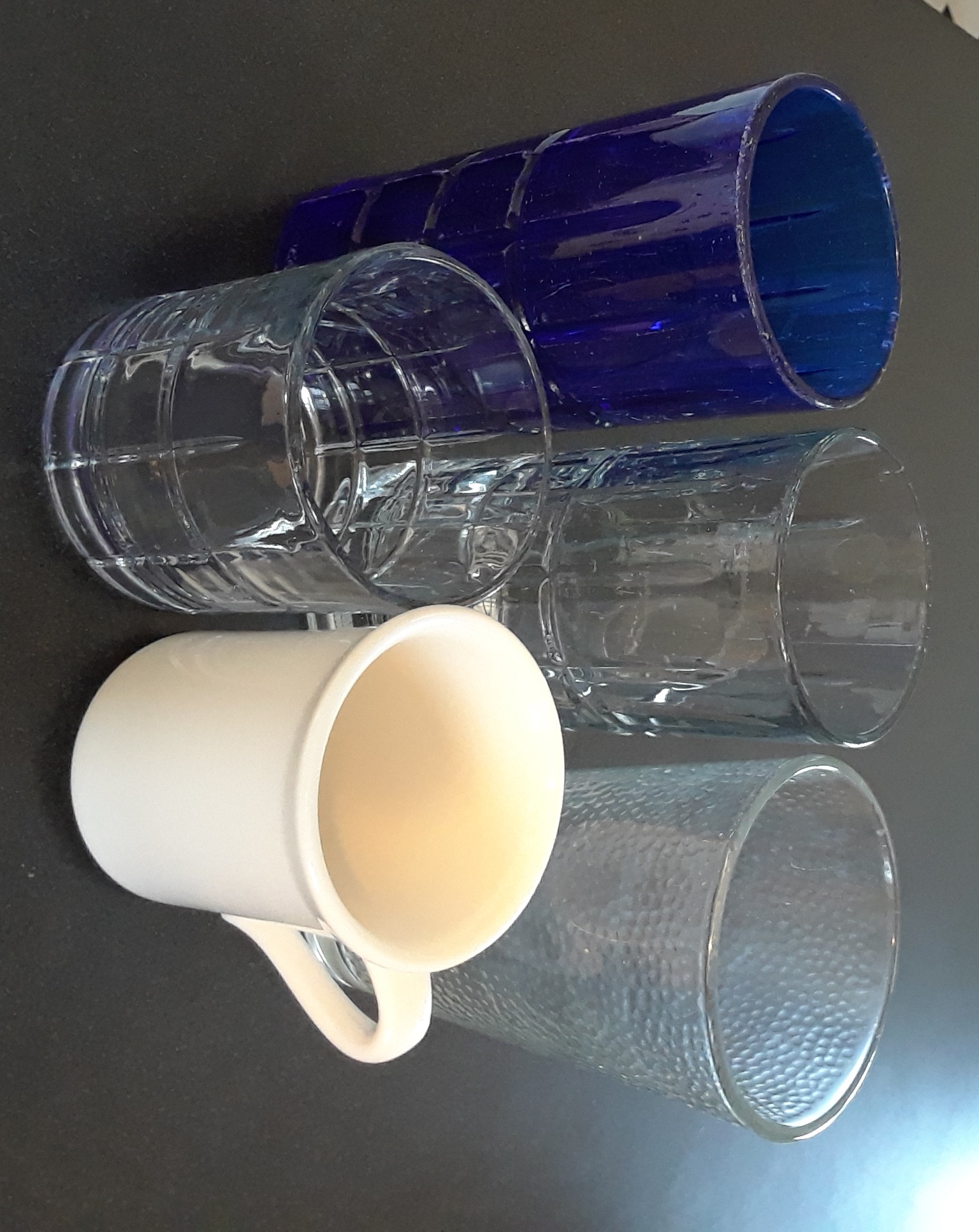 Three new glasses are procured for dinner, all different in pattern and color, and we agree to keep an eye on them for later use. Except my guys don’t, and to make matters worse, they cleared the dinner dishes, mixed up our glasses, and forgot which belonged to them. So you see I simply have to switch to plastic for the good of all mankind or at least to maintain my sanity.
The run on drinking glasses became so bad that we started using mugs. Not that this kept my boys from mixing up which one they had used to begin with. And I even caught the younger one drinking from mine again. I had to abandon my lovely glass (or mug) of chilled water waiting for me on the sink in favor of all three of us grabbing a fresh glass (or mug) every time we wanted a drink. And let me tell you, we’re water drinkers at the Gibson Household…which I suppose is a good thing especially when one is trying to push fluids during an illness.
But seriously, I’m switching to plastic cups. It’ll be me and Solo against all the tree-huggers who claim the popular red receptacle is a hazard to landfills. I can no longer play Jacob in trying to sort out the speckled and striped glasses and who drank out of which one. Procter & Gamble will no longer receive my money for countless boxes of dishwasher detergent every two weeks. Now, I will support Dart Container in my effort to stamp out germs.
In the words of Toby Keith, “Proceed to party!”

Shabbat Shalom to all the creative souls! Your time is now.

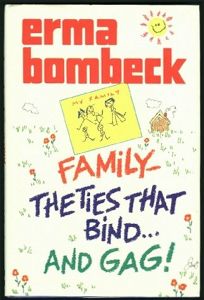 I had never read Erma Bombeck until a literary agency’s query letter specifications required me to find comparable books. I Googled books about families with a strong humor element, wrote down the titles, and placed holds on them at my local library. I also visited Books-A-Million to find the titles my library didn’t own, and I read the book jacket flaps, the opening paragraphs, and random selections throughout the books. One novel in particular seemed like it was going to be close, but I just didn’t feel a connection with it. The comparison to my novel ended up being slim at best. I never finished reading it.
I went back to the drawing board (Google) and refined my search for comparable books. I wanted truly funny family situations, the kind to which a reader could relate and which would make him or her laugh out loud. What I didn’t want were books that pushed someone’s social, political, or religious agenda or books that praised deep-seated dysfunctions in need of therapy and medication. Whatever I did returned a better selection of titles that weren’t just new books and authors, but many classic humor writers, too.
And I discovered Erma Bombeck. I had heard about Mrs. Bombeck as a kid, and I’ve read snippets of her writing usually on refrigerator magnets or bookmarks. At first I worried that her writing would be considered too old or irrelevant to today’s family, or worse, today’s woman. After reading Family – The Ties That Bind…and Gag! I realized that Mrs. Bombeck’s humorous writing is every bit as relevant today as when it was first published.
What appealed to me about Mrs. Bombeck’s writing was that she blended her role as a wife and mother into that of her writing career. She used the years she wasn’t writing for a paycheck to gather material for the times when she could. She made sacrifices without sacrificing her family, and it paid off in fifteen books, a humor column that appeared in nine hundred newspapers throughout the world, and an eleven-year guest appearance on ABC’s Good Morning, America. Mrs. Bombeck held twelve honorary doctorates, was appointed to the President’s Advisory Committee for Women, and was repeatedly named to The World Almanac’s annual list of the twenty five Most Influential Women in America. Pretty impressive for a housewife.
Per Mrs. Bombeck:
Raising a family wasn’t something I put on my resume, but I have to ask myself, would I apply for the same job again?
It was hard work. It was a lot of crud detail. It was steady. Lord, it was steady. But in retrospect, no matter what deeds my life yielded…no matter how many books I had written marched in a row on a library shelf, no matter how many printed words of mine dangled under magnets on refrigerator doors, I had done something rather extraordinary with my life as a mother. For three decades, I had been a matriarch of my own family…bonding them together, waiting for stragglers to grow up, catch up, or make up, mending verbal fences, adding a little glue for cohesion here, patching a few harsh exchanges there, and daily dispensing a potion of love and loyalty to something bigger than all of us.
I cannot tell you how reassured I was to know that Mrs. Bombeck understood the importance of investing in her family. She understood that women aren’t defined by how much they earn or their status in life. She knew that the stay-at-home mother who didn’t make money doing what she did was every bit as important as the woman in the corporate boardroom pulling down millions.
Family – The Ties That Bind…and Gag! was a truly satisfying read, and I hope women today will realize that the greatest thing they can do for themselves is to selflessly serve others. The rewards are endless. Don’t believe me? Reread Erma Bombeck’s list of accomplishments above.

Shabbat Shalom to all the creative souls! Your time is now.

Shabbat Shalom to all the creative people out there! Your time is now.

 The first writing group I ever attended was at the library where I used to work. I had written for pleasure my whole life, but I never did anything with it. Not that one has to do anything with his or her writing. However, when my friend and co-worker mentioned that she was starting a writing group, I was intrigued.
I joined the monthly meetings without any expectations and a lot of desire and nervousness. No one had ever heard my writing beyond my parents and husband. Now I was being asked to share my work with strangers. Reading aloud in group did not come easily to me, and I didn’t do it as much as I would have liked. Even submitting through Google Groups intimidated me.
I kept going to the group but constantly came away frustrated and angry with myself. Then came the day when I realized the writing group wasn’t a good fit for me. I’ll refrain from listing the reasons why so I don’t sound petty or judgmental. The group still exists at a different location, members have come and gone, but the group is solid and I wish them every success.
I joined another writing group that seemed like what I was looking for, followed a few members from there to a new group, and tried two other groups on a hit or miss basis. I kept writing, editing, querying, and blogging, but I felt unsettled. I’d made wonderful friends in the writers I’d met, so what was missing?
A fellow writer from one of the earlier groups invited me to an informal meeting for writers at her home. She writes mysteries as do the majority of the attendees. The invitation to talk about craft and industry was too tempting. I went mostly to observe, listen, and learn especially since I don’t write mysteries.
If memory serves me correctly, that was close to two years ago. In that time an amazing thing happened. I remember the moment it dawned on me that the seven of us had come to trust each other. Every month we sat around the dining room table talking craft, industry, and so much more. Maybe it was the fact that we were all facing each other. Perhaps it had to do with sharing about our families, jobs, fears and joys, failures and successes. Maybe it’s because the group is small, consistent, and all women. Whatever the reason, I know that each of us looks forward to the monthly meeting with the same excitement and anticipation as one would a trip to Disney World combined with a visit to a great therapist.
The connection the group established spilled over into occasional e-mails, then a weekly check-in, and finally the need for a private means of communication via social media for questions and comments not requiring immediate attention or lengthy conversation. The group is a success because we know we’ll be there for each other. The support is invaluable.
I’m sharing this to stress the importance of finding a writing group that works for you. If you have the desire and initiative, create one. Only you can decide what makes a writing group work for you, so don’t stay in one that isn’t beneficial to your writing life. I know I’m where I’m supposed to be because I hate for the meeting to conclude, I miss my fellow writers/friends before I’m even out the door, and I can hardly wait until we’re together again.
Go forth fearlessly and find your tribe.

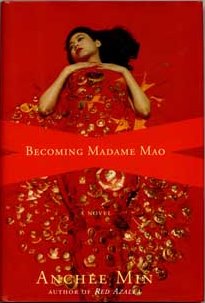 I have never wanted to distance myself from a book as much as I have Anchee Min’s Becoming Madame Mao. I have never wanted a book to end as much as this truth-is-stranger-than-fiction novel documenting the transition of Yunhe to Lan Ping to Madame Mao Jiang Ching. Anchee Min’s bio on the jacket flap states that she “has a personal connection to Madame Mao.” As a young woman, Min was recruited by a talent scout for Madame Mao’s Shanghai Film Studio. I wondered how her close proximity to Madame Mao shaped the story and which parts might have been revealed confidences and which were romanticized imaginings. In either case, there is absolutely nothing about Madame Mao to admire.
The novel initially drew me in with a prologue told in points of view alternating between a third person omniscient narrator and the young woman who would become Madame Mao. The dual storytelling was a refreshing and intelligent approach to revealing the tale as the reader is given an outsider’s view to Madame Mao’s story and then drawn into her perspective complete with emotions and desires, inner details and thoughts. And that is where the good in this book ends.
The woman who became Madame Mao did indeed have a horrible beginning to her life. It marred her existence with overwhelming amounts of insecurity that would haunt her forever. She combatted her fears by throwing herself into her one passion: acting. This allowed her to constantly transform herself into who she needed to be to survive. As heroic as this sounds, Madame Mao never learned grace or forgiveness. Instead, she used China as her stage, cast herself as the leading lady, treated the people of China as mere props, and was nothing more than a lying manipulator who destroyed anyone in her way.
Revenge against people she disliked ended in imprisonment and murder. Actors and politicians who snubbed her, regardless how of long ago the supposed offense took place, found themselves on Madame Mao’s hit list. Jealousy for any woman in a stable marriage, especially if the woman’s husband was close to Mao Tse Tung, poisoned her mind and her actions. She was evil personified, and I cannot feel sorry for her.
The novel has Madame Mao claiming she conducted herself as she did for love. Her twisted version of love was to insert herself in a situation where her affection quickly faded in the face of her true desire to achieve power and rule. Another claim was that she was helpless to act any other way than how she did, and she points the finger back at Mao when she said, “I was Chairman Mao’s dog. I bit whomever he asked me to bite.” She only did this to maintain his favor in the hopes of ruling after his death, and I believe that the cowardly act of denying responsibility for her own actions makes her even more despicable.
As troubling as the history of this psychotic, vindictive woman is, what I find more disturbing is the fact that the history appears to be repeating itself in America. And it’s not even our history. The battle for control of media outlets is one such example. The novel has Madame Mao stating “I feel the power of the media. The way it washes and bleaches minds.” All other forms of media were illegal except her operas, ballets, and films which pushed Mao’s Communist agenda.
America hasn’t reached the level where a simple family feud between a child and a step-parent can end in public humiliation, imprisonment, torture, and death, but every day the news and entertainers denounce major political figures based on rumor and imagination. I fear the “get evidence and produce witnesses” order of Madame Mao’s day is not far off.
Another familiar tactic I recognize was when Madame Mao, together with her husband, upended China by gaining control of the students. Their young impressionable minds were subject to the manipulation, and the Maos made no secret of the fact that they intended to get the students on their side with rallies and speeches meant to whip them into a frenzy of action.
Of course, this begs the question of action toward what end? When looking for understanding and clarification, Marshal Tan Zhen-lin asked Mao, “What is the Cultural Revolution if its goal is to abolish order? Why torture the founding fathers of the republic? What’s the point in creating factions in the army? To tear down the country? Make me get it, Chairman.” Mao responded with a tirade about not allowing anyone to stop the Cultural Revolution, fully supporting the Red Guards, and endorsing chaos and violence as a means of achieving some arbitrary goal. The question of what’s the point, what’s the purpose was left unanswered.
The portion of the reign of terror perpetrated by Madame Mao made her an empress ruling on the ashes of China and the Chinese people. She was at the forefront of the destruction from within. Twenty million lost their lives to this madness. Her place beside the likes of Mao, Hitler, and Stalin is forever secured in history.

 It’s time to take a deep breath and mentally prepare myself for one of my least favorite challenges in my writing life: querying. I remember the first time I queried my novel. I labored over my letter, presenting it to members of my writing groups and submitting it for a paid critique, as if I was writing the Declaration of Independence. Every word had to be perfect. Nothing less than exceptional would do as I crafted this key to unlock the doors to the world of publishing. But never mind the doors; I must first get past the gatekeepers.
Researching agents is a full-time job unto itself. I found literary agencies that represented my genre, and then I located specific agents within the agency. After choosing an agent, I looked to see which authors they had worked with and which titles they represented, hoping to find a title comparable with my novel. Using tips I’d picked up from webinars, I hunted for any connection between myself and the agent. (Did we have similar hobbies and interests, did we grow up in the same state, do they have pets?) All this was before I even sent the letter. Crazy, isn’t it?
Just today my husband wished for me the kind of writing life where I didn’t have to worry about publishing. And what is the concern, really? Can I not create art for the sake of art? Trying to have my work published was my idea. No one forced me to do it. But then I struggle with the question of why write if I’m not going to try to publish, and I start thinking maybe I should find a job. I hate the way money always pops up in my thoughts.
The truth is, I have a supportive husband who isn’t insisting that I find work or publish to bring in a paycheck. When combined with the abundant amount of free time I have, you may wonder what my complaint actually is. Sometimes, I do, too.
There are days I wish I’d never sought publication because I remember how it felt to write freely without that pressure hanging over my head. Don’t think for one minute, though, that I don’t want to be published. Because I do. I’ve invested in my blog and I maintain social media toward the endeavor of publication. My problem is that my two desires are at war in my mind and my heart.
There are also days when I wonder if I’m creating this drama for myself, and I laugh thinking at least I’ll get a good blog post out of it. Because really, it’s better to let this stuff out than it is to hold it in. So again, deep breath.
I am aware of the emotional toll querying can take on a writer, but I’m not ready to abandon my dream. I’ll balance it by realizing how good I have it in that while I’m waiting for replies, I can write freely to my heart’s content. I’ll fill notebook after notebook with words the world will never see. Writing just for me. And once again I’ll…
…Write Happy!

 hl gibson, author