Reading Like a Writer by Francine Prose

I first spied Francine Prose’s book, Reading Like a Writer, while shelving at my former job. I sneaked a few moments to read the first few pages and Reading Like a Writerinstantly fell in love. The sentence that resonated with me, “Like most–maybe all–writers, I learned to write by writing and, by example, by reading books,” combined with, “Long before the idea of a writer’s conference was a glimmer in anyone’s eye, writers learned by reading the work of their predecessors,” confirmed for me that I had found a kindred spirit. Her passion for reading and writing and the process of learning by indulging in both was the best piece of advice I had ever heard. Mrs. Prose’s comments awakened in me what I always believed to be true: great writing is an organic process that comes from creating beyond outlines and plot-pointed structures with perfect character arcs.
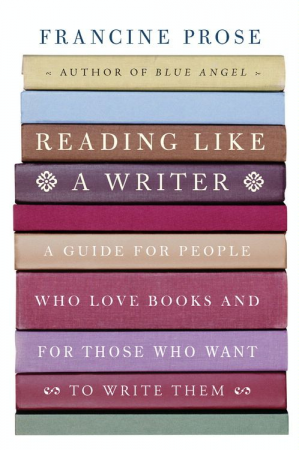
Great writing begins with close reading and follows with careful consideration for every word that will become a sentence, which will become a paragraph. This isn’t to say that Mrs. Prose or I believe writing should be utter chaos without any structure, but I trust if one applied her approach to their own writing, he or she would see amazing growth in how they create characters, employ narration and dialogue, and present details and gestures.

Woven throughout the book are examples from great writers that will back up what Mrs. Prose is teaching. You don’t need to be familiar with these authors or their works to appreciate them. Another reviewer I read proclaimed his dislike for Mrs. Prose’s book because he didn’t know any of the referenced works. I suspect he thought Mrs. Prose was being pretentious; I encourage you not to be intimidated by her knowledge but rather delve into the suggested reading list as soon as possible.

Another aspect of the book that appealed to me is Mrs. Prose’s admission that while there are rules in writing for the express purpose of guiding us, rules are, essentially, meant to be broken. And if you’re brave enough to ride off the reservation of writing rules, make sure you’re breaking them brilliantly.

Regardless of your preferred writing style or approach thereof, I highly recommend reading Francine Prose’s book. I would be truly surprised if you didn’t take away something positive from the experience.

Throwing Down the Gauntlet

Throwing Down the GauntletToday’s blog post originated with a challenge from fellow author, Lucy Flint. I had never heard of the 7/7/7/7 Challenge, but I accepted after reading the rules.

The challenge is extended from one writer to the next. Those who accept 1) locate page seven of his/her current Work in Progress (WIP), 2) count down seven lines, 3) include the next seven lines from his/her WIP in a blog post, and, 4) challenge seven different writers to do the same.

Sounds painless. Furthermore, if I can’t stand up to critiques from fellow authors and followers, what will keep me from crumbling when professional reviews of my writing start rolling in? So, without further ado, here is the appropriate portion to satisfy the challenge from my current WIP, a short story currently titled “The Shape of My Dreams”:

“Excuse me, counselor, but you’re the one who recently lectured me about saving money, especially for our upcoming vacation, and suddenly you have endless funds for decorating. If you’re going to spend money on something, why not upgrade that old door lock with a nice digital security system?”

I throw back the covers and storm off to the bathroom. Mark follows.

“I don’t want to go to Cancun and don’t start on me about the age of this building,” I say around a mouthful of toothpaste.

“Why not?”

Hopefully, you can tell that this argument between my protagonist, Ellen, and her boyfriend, Mark, is not going well. Mark’s snide use of her profession against her only serves to heat up their fight. This story is still largely in my mind and appears in disjointed chunks in my notebook. Accepting this challenge has inspired me to complete it.

Now, I’m nominating:

1) JS Mawdsley (Once for J)

2) JS Mawdsley (Once for S)

3) William Frederick

4) Carrie Tangenberg

5) Marie C. Collins

6) Mark Tilbury

7) Clay S. Robinson

There is absolutely no pressure or obligation to participate if you don’t feel ready to at this time.

Heroes From the Attic by G. Jesse Flynn

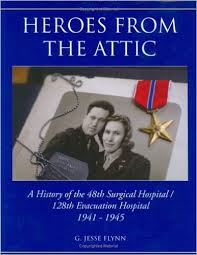
Heroes From the AtticOne of my favorite books, and a feather in the cap of my private library, is Heroes From the Attic by G. Jesse Flynn. I first learned about the book while interviewing participants from the Conneaut D-Day Reenactment this past August. Lisa Merzke, who portrayed a nurse, suggested the book because it explained in detail about the creation of the first MASH unit, the 48th Surgical Hospital, which was later reworked into the 128th Evacuation Hospital.

I obtained an excellent copy of the book and was thrilled to discover the author’s signature in the front cover. Although the inscription isn’t addressed to me, I couldn’t have been more pleased that I owned a signed copy.

Mr. Flynn was prompted to write the history of the 48th/128th upon learning about his parent’s involvement with its formation. Through interviews, letters, diaries, and pictures, Mr. Flynn has constructed a thoroughly detailed accounting that answered my specific questions with such precision that at times I believed the book had been written for me.

As well written as the history is, what truly endeared me to this book were the personal accounts of the members of the 48th/128th. Through the letters of Nurse Lt. Margaret Hornback, the diary of Dr. Leonard Schwade, and individual testimonies of various other members, one gets a true sense of what these brave men and women experienced and how they felt about it.  In an event that, God willing, we never allow to be repeated, members of the 48th/128th often learned on the job but never missed a beat, and they set the high standard of quality by which other units were formed and trained.

I am forever grateful to the doctors, nurses, and enlisted men of the 48th/128thfor their selfless sacrifice. I also thank Mr. Flynn for collecting and recording their amazing history so that it will never be forgotten. Their stories and information helped me to accurately place my protagonist in the European Theater of World War II, and I hope they will graciously indulge my boldness in assigning Dr. John Welles to their most successful and exemplary unit.

Description-A Writer’s Friend or Foe?

dearada_typepad_com_dear_ada_images_2008_01_15_experience_261_artFellow author Mark Tilbury tossed out a question that is often on my mind as a reader and writer. In his post, Have Books Lost Something With Their Lack of Description, Mark asks us our opinion on today’s style of writing.

We’ve all encountered the “massive blocks of descriptive prose” to which Mark refers. Sometimes they truly are too long, too irrelevant to the story, too purple, etc., etc. I have skimmed such passages in search of the storyline and/or dialog that would put me back in the story.

However, because we’re all friends and adults here, I’m going to say that I disagree with the notion that description is informative but unnecessary. I hear all the time that the reader shouldn’t be led around by the nose; he/she should be given the opportunity to imagine the story. As an avid reader, I can honestly say that I have never felt this way about descriptive writing. On the contrary, my imagination was enhanced and grew because of the description I read including that written about journeys and the passage of time.

The key is that writers need to learn the perfect balance between too much and enough, the fine line between well-written, well-placed prose versus that which is encumbering, unnecessary. This seems like a daunting task, but I believe it can be achieved by not reducing writing to a formulaic method. In doing so, authors will elevate writing back to the level of artistic recognition it deserves.

85806_Ashford_1_122_526lo_122_526loI have never read Stephen King’s book, On Writing, but I would have to agree that abundant description about a character’s acne would be tedious. If that acne-plagued character traveled by canal boat from Pennsylvania to Ohio, then I would love the benefit of description. I would look forward to a word picture painted by the author that draws me in to the sounds, smells, and sights of the trip. It would be a perfect place to introduce traveling companions, a time for the protagonist to reflect, an opportunity to build the tension that so deliciously moves the story forward.

Even if none of the above-mentioned suggestions occur, as a reader I would still enjoy the mental images of traveling with the character, and I believe an important part of the writing would be lost if these well-written descriptions didn’t occur. As Mark mentioned in his post, they are an art form unto themselves. Like all art, value thereof still resides in the eye of the beholder, or in this case, the reader. Well-written description can exist purely for the sake of entertainment.

I have to wonder if writing hasn’t gone the way of food preparation in that we no longer know how to linger over a book in the same way that we forego multiple course meals and choose to patronize fast-food restaurants. I read because I enjoy the slower pace, and while there is a place in my fa9bbdedb5103e7f31a0893eff84ed56reading diet for the occasional literary Big Mac, more often than not, I opt for the balanced meal of description, dialog, prose, and narrative.

Now I don’t want to start a fight with screenwriters because I truly do appreciate their craft. However, using what worked in an action-packed movie and applying it to writing has resulted in fast-paced novels written with the singular hope of being turned into a movie. This has diminished writing for some of us. This influence has led to the removal of poetry and painting (mental images) from writing resulting in flat, hollows stories. Let movies be movies, appreciate them for all that they are; and let books be books, treasures not to be rushed through.

The Homesman – Movie Review

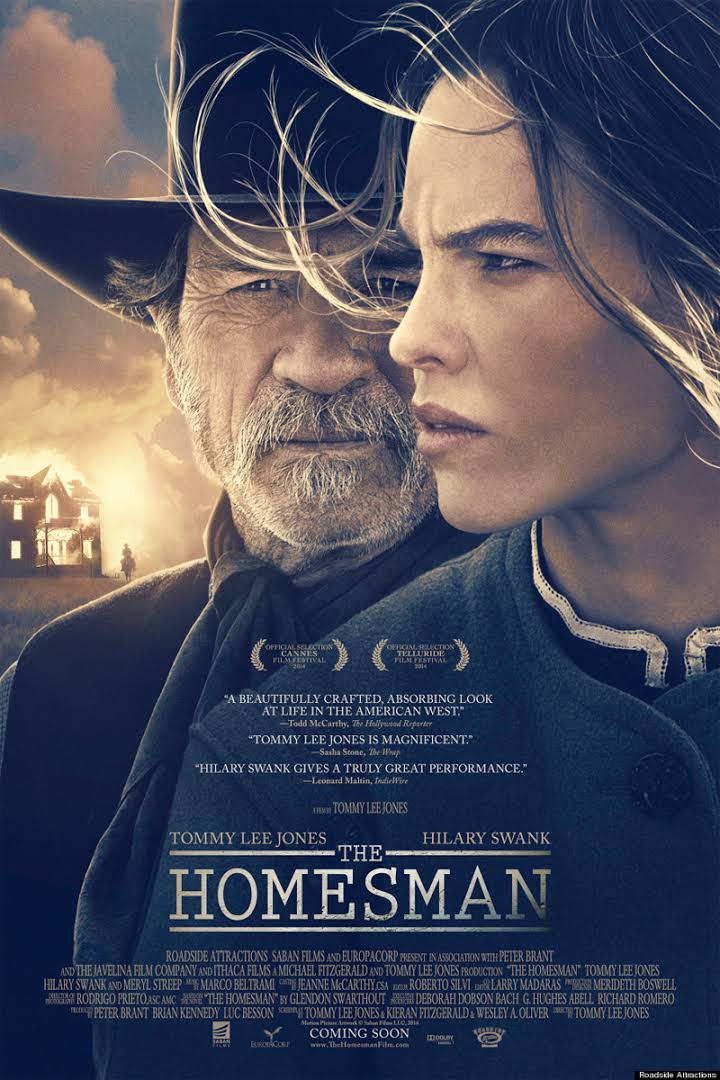
images (3)One of the best movies I have seen in a long time is The Homesman, directed by Tommy Lee Jones. Mr. Jones stars as George Briggs, a claim jumper saved by pious spinster, Mary Bee Cuddy, played by Hilary Swank. The performance of these two Oscar-winning actors is brilliant as they draw you in to the stark reality of life in the 1850s American West.

In return for sparing his life from hanging, Briggs is pressed into service as a homesman by Mary Bee. A homesman is someone who accompanies people back home when they become too ill to survive life on the plains. In the case of three women who have experienced hardships beyond their endurance, severe mental illness necessitates removal from their families.

There are harsh and disturbing images in the movie, but in the hands of a director like Tommy Lee Jones, they don’t come across as cheap, shock value scenes. Factor in an all-star cast of characters in fabulous cameos, an unexpected mid-movie twist, and visually appealing cinematography and The Homesman presents the makings of a classic film.

I don’t want to start a firestorm debate on book versus movie; however, I’m anxious to see if the novel lives up to the quality of the movie. I researched the novel and author and was pleasantly surprised to find that Glendon Swarthout is also the author of the novel, The Shootist, which inspired the 1976 movie and is best known for being John Wayne’s last film. Admittedly, I’ve never read a western, but I am interested to give Mr. Swarthout’s The Homesman a try if for no other reason than to see how closely the movie follows the storyline.

Let us not forget Marco Beltrami’s beautiful yet haunting musical score which perfectly matches the scenes from the movie. If movie music allows you to recall and relive the scenes as if you were watching them all over again, I believe the score deserves the mark of excellence. Marco Beltrami achieves this with a score that is powerfully subtle, always blending with the scenes rather than jarring you out of them, and certainly memorable.

Whether or not you are a fan of the western, I believe you will find The Homesman an enjoyable movie not to be missed.

Baring My Writer’s Soul – Part 6

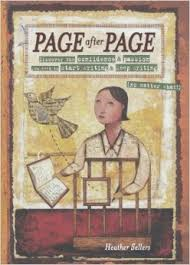
untitled (8)I struggled a bit with chapter two of Page After Page because I couldn’t relate to the exact experiences Heather Sellers presented, and her advice seemed to contradict other things I’ve been told, most specifically regarding social media. While she didn’t address social media directly, what she proposed would require a noticeable change in how I handled the various aspects of my author platform.

Rather than allow my resistance to flare, I decided to go forward with closing the gap between my writing life and the rest of my life because I am a writer, plain and simple, whether or not I’m published, all the time, period. I’ll do this by drawing on all the positive writing and reading experiences, thus quelling my fears and doubts. This will be an ongoing process for me. At least I know how to seek out and find quality input.

As for conserving my energy to write, that’s going to require a step back from social media. What an unusual request when we live in an era that is all about social media. How can I build/grow/maintain my author platform if I’m not tweeting, posting, honking, and tooting my own horn, shouting, “Hey, look at me! See what I’m writing?” Whose advice do I take?

Let’s consider the point Ms. Sellers makes when she says that talking about writing all the time means you aren’t actually writing. That’s true. Then there are all the stats on social media to gauge how well we’re liked, or not, which can really make or break one’s confidence. I decided to trust Ms. Sellers and withdrew to a safe distance.

The first couple of days felt as if I didn’t have anything to do. I picked up my pen and wrote, and I listened to the voices of the characters in the book I’m reading, and I treated myself to two new writing books, and I read, and I wrote, and I scratched out what I had written, and I listened to the instruction presented in my new writing books, and I wrote some more.

The best part is I don’t have to tell you what I’m writing; that’s for me. What I will share with you is that Page After Page, Story Trumps Structure, and Fiction Writing Master Class have been phenomenal in breaking through my resistance and writer’s block.

The positive momentum kept me moving forward. In addition to my writing group, I joined a book group online and at the library, and I will be attending two “Meet Your Local Author” events. I know this is going to further enhance my writing because I’m all about the tactile experience.

Never fear, though. I shall not abandon my blog. I’m just tweaking the focus to build a community of reading, writing, interactive friends whose presence in my life goes far beyond that of just follower.

Write Happy!

Baring My Writer’s Soul – Part 2

untitled (8)Many thanks to my Twitter friend, Lucy Flint @flintily, for mentioning the book Page After Page by Heather Sellers. I immediately checked it out based on her recommendation, but after reading two chapters, I had to order my own copy from AbeBooks.

The excruciating wait for my book to arrive was lessened by the brilliant idea that popped into my head:   why not blog about my personal experience while reading the book? Immediately, self-doubts arose which was kind of funny because chapter one addresses this issue.

Page After Page is short, action-packed, conversational, “how to” in its voice without being preachy, and applicable to writing as well as other endeavors in life.

I’m inviting you to come on this journey with me, but you do not have to feel obligated to do so. In reading Page After Page, I’m learning from Heather Sellers’ process and picking up useful, relevant information and instruction that meets my writing needs.

If you find something that resonates with you, run with it. If not, don’t feel discouraged; what you’re looking for may be in the next post, by me or someone else, or a different writing book.

Write Happy!

Baring My Writer’s Soul – Part 1

untitled (5)“Every secret of a writer’s soul, every experience of his life, every quality of his mind is written large in his works.”  Virginia Woolf

I’m not an inspirational author, but I do find that there is a large amount of room in my writing for inspiration. Most specifically, I’m looking for the kind of inspiration that comes from giving my writing life over to God.

Recently, I’ve been discouraged with trying to balance my non-writing life with my writing life. Writing became a chore, and I lost the joy of creating. Still, I pushed myself to write because I believed I absolutely had to. Or maybe I didn’t.

There are a lot of people in life who will gladly define for you what it means to be a real writer. I’m tired of trying to force myself into their labels and definitions much the same as I’m tired of trying to force my writing into their preferred methods and styles. I needed to find what worked best for my life and my writing.

When I stepped back and prayed, the miraculous occurred. The return of my happiness was the first, most noticeable change. Second was the disappearance of the guilt I experienced for not writing and/or maintaining my author platform every minute of the day. In fact, I haven’t written for two days, and I finally spied my writing muse peeking around the corner to see if it’s safe for her and my enthusiasm to return.  Keep in mind I’m no quitter; I just needed a break.

Then I reprioritized my life into God first, family second, work third which led to harmony. I reduced the real distraction of social media and welcomed back my responsibilities of homemaking.  That last point may sound old fashioned to some people, but by completing my family duties, I cleared my mind to focus when I needed to write.

Lastly, I’m working on ridding my mindset of the lie that I’m racing against some unknown, unseen deadline to be successful or die in unfulfilled misery. When I did that, my overbearing sense of competitiveness and envy withered. I realized that success and happiness are not the same things, and they rarely go hand in hand.

By allowing myself to step away, I’ve gained a new perspective on writing and life in general. I already am a successful writer, even if I just write for myself, because I am a happy writer. How do I know I’m on the right track? Since these revelations came to me over the past few days, I received encouragement in the form of Tweets, posts, and blog articles such as the one by Jennifer Slattery, When Discouragement Swallows Your Strength, via Castle Gate Press.

It could be a coincidence, but coincidence is God’s way of letting us know He’s still in charge.

Write Happy!

Favorite Author & Multi-Book Review

untitled (6)Joanna Trollope is my favorite writer when it comes to working through the family situation. Her well-written characters are as diverse as the personalities one encounters in his or her own family and just as frustrating. I’ll no sooner have my favorite characters chosen only to have him/her say or do something completely stupid, and my allegiance changes to the character I used to hate. In this way, Mrs. Trollope reels you in and casts you back throughout the story.

The way in which she presents real-life, everyday situations isn’t boring in the least. Her ‘fly on the wall’ perspective into the lives of her characters offers the same guilty pleasure as witnessing private conversations and/or arguments.

Further, her conclusions aren’t always neat and tidy happy endings. Much like real life and family, there is a definite end to the situation, but rarely does it go well for everyone. You’ll struggle, suffer, rejoice, and celebrate right along with Mrs. Trollope’s characters, often identifying with them or recognizing them in your own family members.

I haven’t read everything written by this author, and I haven’t experienced her writing under her pen name Caroline Harvey. What I have read has been enjoyable, the most recent being Daughters in Law. Her novel, Other People’s Children, received my strongest reaction. As expected, the book is replete with interesting characters in different walks of life. There is, however, one character in particular who I fantasized killing in the most heinous ways imaginable long after I had finished reading the book. That may sound horrible, but I believe it’s testimony to Joanna Trollope’s excellent writing skills.

Here is a list of Joanna Trollope’s novel in order of publication.

Blood-Red Pencil: Things That Drive An Editor Crazy

Today’s advice comes from The Blood-Red Pencil, a weblog hosted by a team of editors.  The post I’m sharing was written specifically by Maryann Miller, author and freelance editor.  Her post originally ran October 7, 2008.  I know you’ll find her advice is every bit as relevant today.  Enjoy! 

Blood-Red Pencil: Things That Drive An Editor Crazy.