La Cucina Povera

In the chapter of my novel, The Tedescos, titled “Soul Food,” the family attends church on Mother’s Day with their good friends, The Robertses. After the service, the Tedesco Clan is invited to attend a meal in the church fellowship hall. The men and boys prepared the meal they will serve to the mothers to honor them. Much of the food the Tedescos encounter is familiar, but one dish in particular initiates a conversation between Joe Jr. and Tabitha and Tonya Roberts and results in the explanation of ‘la cucina povera.’

The Italian phrase literally means the poor kitchen, and it is a style of cooking familiar among the lower classes (think peasants) of a particular society. Often, peasants had to cook with whatever they had on hand whether it came from the kitchen or the farm. The ‘poor kitchen’ can be found in every society. The great thing about this concept is that some really delicious recipes emerged from the simple, high-quality ingredients that were available.

Attempting to cook in the style of ‘la cucina povera’ may earn you a laugh especially from an older person who lived through the war in Italy. They may refuse to acknowledge ‘the poor kitchen’ style and argue that it was simply the preparation of the food they had on hand. Americans, with all their varied food choices and easy access to said food, have a tendency to romanticize a style of cooking that was a part of basic survival. Still, I can think of several recipes in which my family indulges that found their way into my writing because of my love to feed people whether real or imagined. Many cookbooks featuring this style of food have been published, and I highly recommend you try one or two meals from them if you’ve never encountered peasant cooking.

Beans and cornbread, cabbage and noodles, and soup made from some combination of vegetables are the types of peasant food I grew up with. I never knew that what we ate was considered to be from ‘the poor kitchen’ because the adults who prepared it for me cooked with love and made everything taste wonderful. Delicious, simple food is usually the tastiest, and in the end, that’s really what it’s all about. What does your family enjoy from ‘la cucina povera?’

Ancient Canine Proverb

Sister Mary Agnes is a peripheral character in my novel, The Tedescos, but she is one of importance as she lends emotional and spiritual support to the Tedesco Family. In a chapter where she and Shirley Tedesco are at the hospital waiting for a very important outcome, the nun asks Shirley if they should go check on the men meaning Joe and his friends. Shirley replies, “Nah, let sleeping dogs lie.” The phrase means to avoid interfering in a situation that is currently stable, and Shirley certainly didn’t want Joe and company hovering around and mucking things up.

The expression is based on the observation that dogs are often unpredictable when they are startled awake. What started out as a warning about the risk of waking a potentially dangerous animal became metaphorical. The ‘leave well enough alone’ proverb has evolved from the days of Geoffrey Chaucer (“It is nought good a slepyng hound to wake.” – Troilus and Criseyde, circa 1380) and John Heywood (“It is euill waking of the slepyng dog.” – A Dialogue Prouerbes English Tongue, 1546) into more modern versions including ‘if it ain’t broke, don’t fix it.’

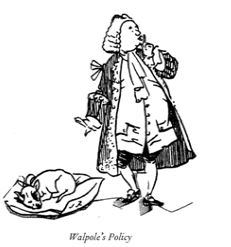
There is also a legend that credits 18th century British politician Sir Robert Walpole with the proverb, claiming that it was also his motto. Apparently, the saying does not appear in Walpole’s published writings nor does record exist of him ever saying it. Perhaps he applied some version of the phrase to his political policy, but that’s as far as he and the phrase go although a lovely little cartoon of Sir Robert exists based on the proverb.

As serious as this explanation sounds, Joe and his buddies wouldn’t have responded as a vicious dog would, but their presence still wasn’t required by the ladies.

Don’t Have a Heart Attack

You know how it is. You’re typing away in Word, and maybe you truly aren’t aware of the difference or maybe you just made a typo, but in either case the blue squiggles have shown up under one or two words. I don’t often experience the blue squiggles. I’m familiar with the red (misspelled word) and the green (fragment). But when I see the blue squiggles, I know something is wrong.

It happened recently when I typed the word anymore. Making anymore into two words solved the problem, but I couldn’t let this correction go without re-familiarizing myself with the why behind it. Never hurts to brush up on my grammar, not to mention it makes a great blog post for The Weight of Words.

Any more and anymore have related meanings, but they are not interchangeable. How you use it will determine whether you type or write it as one word or two. Any more deals with quantities such as:

Would you like any more cookies?

Anymore is an adverb and has to do with time:

I don’t like cookies anymore.

A quick check to see if you need the single-word version is if you can switch it for the word nowadays. One source claimed this usage to be unacceptable in formal writing and quite rare, however, I believe it would add flair to one’s writing whether in the prose or as dialog. I also am a great proponent for keeping alive interesting words deemed archaic.

Another interesting fact regarding anymore vs. any more is that the traditional though less common spelling was as two separate words: any more. Apparently, in the last fifty years, anymore has increased in use giving rise to the one-word and two-word spellings, distinct definitions, and usage.

Monkey Business

Ava Maria Tedesco is a tender-hearted girl of thirteen. While she knows that stuffed animals aren’t real, she can’t quite help but extend to them the same compassion she showers on animals, people in need of prayer, sometimes her siblings, and always her parents, Grandma Josephine, and Sister Mary Agnes. One of Ava’s favorite stuffed animals is Mr. Monkey. Unfortunately for Ava, her older sister, Katherine, knows this. Katherine only meant to kidnap Mr. Monkey for a short time to torment her younger sister, but when she hides the rubber-face stuffed toy in their mother’s dryer, all does not end well.

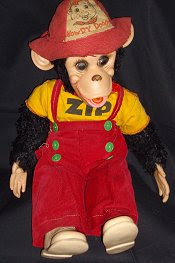
I based Ava Maria’s favorite stuffed toy on one I had as a child. In fact, Freddie is still packed away in my basement with all my other childhood stuffed toys even as I type. I don’t know where I obtained Freddie or how that came to be his name. I just remember being fascinated by his rubbery face, hands (one of which holds a banana), and little white shoes. Even before I can remember, one of Freddie’s shoes somehow became slightly detached from his hairy legs and had to be safety pinned in place.

When I researched the doll for my novel, The Tedescos, I came across pictures of the one I had as well as one with the word Zip on the front of his yellow shirt. The Zip doll was the representation of the actual chimpanzee, Zippy, who was a television star in the 1950s. Zippy had been discovered by Bob “Buffalo Bob” Smith of Howdy Doody fame, and the chimp appeared on the show. Zippy also appeared on The Ed Sullivan Show, Captain Kangaroo, Gary Moore Show, and Jackie Gleason Show.

The Ruston Company made the Zip stuffed doll in response to Zippy’s popularity on Howdy Doody. Howdy Doody ran from 1947 until 1960, and while I have yet to find documentation supporting this fact, either The Rushton Company continued to produce the popular stuffed doll long into the 1970s (my childhood) or children took extremely good care of their toys. Another possibility allowing the doll to make it into the 1970s is what I call ‘the knock-off’ factor in which Zip lookalikes, such as the one I have, were produced well beyond the demise of the Howdy Doody show. Columbia appears on the tag of some of these dolls identifying them as made by another toy manufacturer.

My version of the rubber-faced monkey doll is apparently known as Mr. Bim, and he may or may not be holding a banana, have red suspenders or black pompom buttons, and have yellow or white fur representing a shirt. In 1984, Dakin produced an updated version of the Zip doll.

In addition to the stuffed monkey dolls I’ve described above, there are a whole host of monkeys in other colors of fur, with or without hats, some with different facial configurations, and more. So while my Freddie and Ava Maria’s Mr. Monkey might not be original Zip dolls, they are no less loved.

Bad Medicine

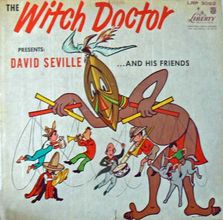
One of the weirdest things I had to research for my novel, The Tedescos, was the song “Witch Doctor.” I checked first of all to make sure it had been released before my story took place. The song, performed by Ross Bagdasarian Sr., was released in 1958 by Liberty Records. Bagdasarian is better known by his stage name David Seville.

The song peaked at number one on the Billboard Top 100 and was considered a surprise hit on the chart. “Witch Doctor” became David Seville’s first number-one single and held this position for three weeks. The single sold over one million copies in the United States and finished at the number-four spot on Billboard for 1958.

The ridiculous song tells the story of a man in love with a woman who does not feel the same way about him. In an effort to secure her affections, the man visits a witch doctor for advice. The witch doctor replies with the now-famous refrain, “Oo ee oo aa aa ting tang walla walla bing bang.” This phrase is repeated throughout the song with the alternating endings of “bing bang” and “bang bang.”

And let me tell you, there is heated debate to this minor detail. Some people will sing every line of the witch doctor’s comments as “bing bang” while other sticklers for detail will insist upon singing it the correct way as “bing bang” the first time followed by “bang bang.” I actually watched the video of David Seville singing the song, my eyes narrowed in concentration to read his lips, just so I could settle the dispute.

The witch doctor’s voice is Bagdasarian’s own voice sped up to double speed. This technique was later used when Bagdasarian, as David Seville, created Alvin and the Chipmunks.

Grandma Josephine Tedesco borrows the witch doctor’s famous line when her youngest son, Danny, involves her in a crazy, money-making scheme. Because Grandma Josephine isn’t always aware of what she’s doing, she’s given a pass. However, Danny does not fare so well when his older brother, Joe, finds out he employed their mother in shady business.

Since I don’t want to be the only one with this annoying lyric stuck in my head, I have provided a link to Ross Bagdasarian/David Seville singing “Witch Doctor” on The Ed Sullivan Show.

Meet the Tedescos

As I prepare to query my novel, The Tedescos, I thought I’d better introduce the family to you so you’ll know who I’m talking about in upcoming blog posts for Research Road and Edible Fiction.

Joe Tedesco is the big-hearted, sometimes clueless, but always lovable patriarch of the Tedesco Clan whose primary job is to bring home the bacon and do his best to not muck things up too badly for his lovely wife, Shirley.

Shirley Tedesco is the savvy, stay-at-home matriarch of the Tedesco Clan responsible for keeping her husband, their brood of eight rowdy children, and her crazy mother-in-law in line. Hers is a difficult task.

Sixteen year-old Joe Jr. is the good-natured, oldest sibling with a love for sports, girls, and food, but not necessarily in that order.

Katherine, the second oldest sibling at fourteen, is a mastermind of manipulation who knows how to play her father for whatever catches her eye.

Thirteen year-old Ava Maria is the saintly, third oldest sibling whose limitless compassion extends to stuffed animals, overworked nuns, and anyone in need of prayer.

Holly and Noelle, ten years-old, are the pink and blue wearing Christmas twins possessing twice the sweetness or twice the mischievousness depending on what the situation requires.

Billy (age seven), Grace (age six), and Pauline (age five) are the youngest three siblings who work as a unit whether it’s planning or executing the next round of trouble they’re going to get into.

Grandma Josephine, Joe’s widowed mother, lives in the twilight realm between long-term memory and reality as she navigates her way through the golden years.

Danny Tedesco, Joe’s younger brother, is the unmarried, shiftless member of the family who is long on money-making schemes and short on work ethic.

The Artist’s Corner – Tracking Down the Facts With Author Jane Turzillo

I first met author Jane Turzillo at an informal meeting for writers. Jane writes non-fiction that requires her to complete extensive research. Recently, she shared her research techniques and online resources at a presentation at the Hudson Library & Historical Society. After attending the presentation, I invited Jane to interview for The Artist’s Corner to share some interesting history about herself as well as the many links she uses when tracking down facts for her books.

Whether you write fiction or non-fiction, I’m sure you’ll find the links Jane provided beneficial to your search for information.

Tell me a little bit about yourself.

I guess I’ve done a little bit of everything. I started out at college (Miami University in Oxford, Ohio) on a vocal scholarship as a music major, but it just wasn’t my calling, so I quit. I’ve worked for construction companies, a cosmetic store, and a few clothing stores. I even taught piano for a while. Then I went back to school at The University of Akron to get a degree in criminal justice because I had dated a cop and became fascinated with police work. I realized I loved investigation, plus I knew I wanted to write crime and mystery. I also love going to school, so I went on to get a degree in mass-media communication.

I’ve worked in the development office of a private school and taught at a business college. I even worked at a travel agency for a few minutes. One of my favorite jobs was at the Akron Art Museum, where I was the public information assistant. Before I retired, I went back to the museum to work in the store part time. I also worked for two weekly newspapers. One of them, the West Side Leader, I co-owned. I was the police and fire reporter. That was also a lot of fun. I enjoyed riding with the police on weekend nights. One of those nights, I saw Jeffrey Dahmer sitting in the back of a cruiser, having been arrested for the first time. This was before we knew what a monster he was. Another case that I covered, and will always stick in my mind, was the murder of Dean Milo. The case stretched on for a year, but in the end eleven people were arrested, tried, and convicted of his murder.

I now work fulltime as an author and presenter. It is the best job in the world!

To which professional writing organizations do you belong?

National Federation of Press Women, Mystery Writers of America, and Sisters in Crime

How did your work experience contribute to your desire to write books?

Everything contributes to my desire to write books because I get ideas from my surroundings, whether it’s a person or situation I dealt with during my work experience, or a newspaper article that piqued my interest. Once I get an idea, I think “what if.” It just goes from there.

Why did you decide to write non-fiction?

I fell into nonfiction when I first started to write seriously. A friend and I had been to a writer’s conference given by Western Reserve Magazine. The editor told the group of wannabes how to break into the magazine. I was excited after that and needed a subject. It came in the form of an old-time counterfeiter whose story was in a book I picked up at the Summit County Historical Society. My first publication (that I knew of) was in Western Reserve Magazine. It was not on the counterfeiter but on a pioneer woman from our area. When I say “that I knew of,” years later, I got two contributor copies of a small magazine that published a short story I had written and forgotten about.

What are you favorite non-fiction topics to write about?

Crimes and trains in history. I’m in love with the research. I guess it’s the thrill of the chase.

Which historical figure did you most enjoy writing about?

Whichever one I’m writing about at the moment. This is something I’ve been asked lots of times, so I’ve had a chance to think about it. I always come up with the same answer. I like the madams:  Ardele Quinn in Wicked Women of Northeast Ohio and the four, Lizzie Lape, Rose Pasco, Clara Palmer, and Ginger Pasco, from my next book Wicked Women of Ohio. I’m also fond of “Akron Mary,” a bootlegger’s girlfriend, and Sarah Robinson and Annie George who shot boyfriends who treated them poorly all from Wicked Women of Northeast Ohio.  Sheriff Maude Collins of Wicked Women of Ohio joined the list this year.

What non-fiction title and/or topics do you enjoy reading?

This year’s favorites are: Killers of the Flower Moon by David Grann about the murders of Osage Native Americans who discovered oil on their land in Oklahoma during the 1920s; Pirate Hunters by Robert Kurson about two deep sea treasure hunters searching for the pirate ship the Golden Fleece that sunk during the seventeenth century; and Hillbilly Elegy by J.D. Vance, a first person account of an ex-marine/Yale-educated attorney growing up in the Rust Belt.

Which authors do you enjoy reading?

My reading habits go in spurts. I’ll find an author that I really like and read everything that he or she has written. I like mysteries the most. Right now, I’m into western mysteries, and I like Craig Johnson. I’ve always liked Tony Hillerman. Michael Connelly, James Lee Burke, and John Grisham never disappoint me.

How have these authors shaped your writing life and/or style?

I pick something up from every book I read—whether it’s writing that I think works well, or something in the plot.

Tell me about the books you’ve published.

Wicked Women of Northeast Ohio—ten women who didn’t play by the rules, eight murderesses, a madam, and a bootlegger’s girlfriend.

Murder & Mayhem on Ohio’s Rails—ten train robberies and murders right here in Ohio.

Ohio Train Disasters—twelve of the worst train collisions in Ohio, including the 1876 Ashtabula bridge disaster, which still ranks as one of the worst in the country.

Unsolved Murders & Disappearances in Northeast Ohio—eight unsolved murders, plus the disappearance of two children.

Wicked Women of Ohio—twelve more lawbreaking women from the state. Due out in June.

Where can an interested reader find your books?

They are available at almost any independent bookstore in Ohio or on Amazon, Barnes & Noble, and Books-A-Million. Even Giant Eagle carries them.

Describe your research process.

That’s a tough one because every subject takes me in a different direction. I’ve been out on lonesome dirt roads, in cemeteries, libraries, churches, police stations, court houses. I read old newspapers, track down relatives, talk to other historians and townspeople. I go wherever the road leads me, and I love every minute of it.

Will you share your favorite research sites with us?

Genealogy Bank

Newspapers.com

NewsLibrary.com

Google News Archive

Newspaper Archive

Ancestry  When accessed through your public library, you can search more for free.

Find a Grave

New York Times Article Archive  Requires a subscription

National Archives

FBI Records:  The Vault

Library of Congress

Cuyahoga County Department of Public Works Archive

The Charley Project Missing persons

Ohio History Connection

Cleveland Public Library

Cuyahoga County Public Library

Akron-Summit County Public Library

Where can one find you on the Internet?

My blog is Dark Hearted Women

Old Literature, New Words

Nothing like a great classic to bring up some words you may know, but weren’t aware had interesting multiple definitions, and a few you may not know.  I’m sure you’ll want to add these to your vocabulary, work them into your writing, and use them to win a round of Jeopardy.

First is beetling.  When I came across it in a sentence, I thought I knew the definition of the word, but its usage didn’t make sense where it had been written.  So, I went in search of the definition that would fit the sentence.

As a verb, beetling can mean:

Make one’s way hurriedly or with short, quick steps.

To use a beetle on; drive, ram, beat, or crush with a beetle.

To project or overhang threateningly.

As a noun:

A heavy hammering or ramming instrument, usually of wood, used to drive wedges, force down paving stones, compress loose earth, etc.

Any of various wooden instruments for beating linen, mashing potatoes, etc.

Any insect of the order Coleoptera, having biting mouthparts and forewings modified to form shell-like protective elytra (two-wing casing of a beetle).

As an adjective:

Projecting, overhanging.

That’s quite a few definitions for a word that sounds rather cute when you say it.  Try it this way:

But just then the moon, sailing through the black clouds, appeared behind the jagged crest of a beetling, pine-clad rock, and by its light I saw around us a ring of wolves, with white teeth, lolling red tongues, with long sinewy limbs and shaggy hair.

Now it doesn’t sound so innocent, does it?  Clearly the adjective of beetle was the one the author had in mind.

Let’s move on to prosecuting.  I don’t know about you, but I instantly think all things legal when I hear the word.  A verb all around, drop the –ing and head straight for prosecute to discover what it means:

Institute legal proceedings against (a person or organization), institute legal proceedings in respect of (a claim or offense), and (of a lawyer) conduct the case against the party being accused or sued in a lawsuit.

See what I mean about the legal thing.  But press on a titch to find:

Continue with (a course of action) with a view to it completion.

And the archaic:

Carry on (a trade or pursuit).

Consider the sentence:

I think had there been any alternative I should have taken it, instead of prosecuting that unknown night journey.

Our character is fearful of his surroundings and the strange goings-on, so no doubt the second definition of prosecute applies here.

The last word is a fun one and needs to be worked into conversation at every opportunity not unlike the word huzzah.  Try faugh on for size.  The exclamation is used to express disgust, and I came across it in the sentence:

I am alone in the castle with those awful women.  Faugh!  Mina is a woman, and there is nought in common.  They are devils of the Pit!

You might believe the author is writing about the Kardashians, but he’s not.  The women in question are vampires, and if you haven’t figured it out yet, I’m reading Bram Stoker’s Dracula.

I wasn’t going to mention this word, but lest anyone think I’ve misspelled it, nought in the sentence above is not spelled incorrectly; it’s a variation of naught.  But you, brilliant follower, already knew that.

Where Are We Going With This?

The other day I banged out a sentence on the ole laptop and paused when my son interrupted my thought process to ask a question.  When I returned my attention to the sentence, one word in particular caught my attention.  My head tilted as I assessed the word, questioned the spelling.  Strangely enough, the obnoxious red squiggles Microsoft Word is so found of hadn’t appeared, so I assumed I’d spelled it correctly.  Still, something didn’t look quite right.  Or perhaps I should say spot-on.

Perhaps you’ve guessed by now that I spelled the word in question, travelling/traveling, as if I was writing for our friends across the pond.  I mentioned before in How Reading Taught Me to Misspell Words that I’ve been tripped up by the British spelling preferences.  Usually, Word catches them.  Not so this time.

I’ll cut to the chase and tell you that travelling and traveling are both verbs meaning to go from one place to another, as on a trip or journeyThis isn’t a case of a second or third definition.  In fact, the two spellings can be used interchangeably.  What’s more, what I’m about to tell you applies to travelled/traveled and traveller/traveler.

So what’s the difference, you ask?  There isn’t one.  Today’s The Weight of Words is another example of British versus American spelling preferences.  British writers employ the double L version of the word and American writers go for the single L spelling.  No big deal if you’re jotting off a note to someone or a private letter.  But if you’re writing a larger work for a particular audience or about Brits or Americans specifically, it might be wise to use a spelling your intended readers will not think is a mistake.

A tidbit of research uncovered the reason behind the differences in spellings:

Each word has its own unique history, but the primary mover and shaker in this transatlantic drama is the nineteenth century American lexicographer Noah Webster, he of dictionary fame.  According to “A History of English Spelling” (Manchester University, 2011) by D.G. Scragg, Webster’s dictionary of 1828 is largely responsible for standardizing the accepted spelling of American English.

Before 1828, many words, such as humor (or humour), defense (or defence) and fiber (or fibre), had two acceptable spellings on both sides of the pond, because they were introduced in England via both Latin and French, which used different spellings.  Webster picked his preferred forms (the former ones in each example above), justifying his choices in various ways, but partly on nationalist grounds:  he wanted American spelling to be distinct from, and (in his opinion) superior to, British spelling.

I can appreciate Mr. Webster’s patriotism, but sometimes I wish he’d chosen another way to express it rather than in different spellings.

~~~~~

Wolchover, Natalie. “Why Do Brits and Americans Spell Words Differently?” LiveScience, Purch, 17 Apr. 2012, http://www.livescience.com/33844-british-american-word-spelling.html.

To Praise with Admiration

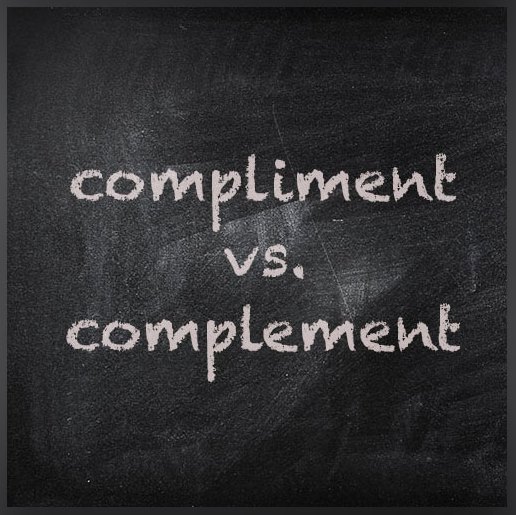
For far too long those crazy Latin-speaking people have influenced English to the detriment of high school students everywhere.  Until we can stop them, here’s some information on compliment versus complement.  No doubt the confusion started with the fact that they are pronounced alike and used to have similar meanings.  Fortunately, they evolved into separate words.

The older of the two words, complement with an E derived from the Latin complementum.  As a noun, complement means “a thing that completes or brings to perfection” and “a number or quantity of something required to make a group complete.”  As a verb, it means “to add to (something) in a way that enhances or improves it; make perfect.”

Noun 1:  The lyrics provided the perfect complement to the music.

Noun 2:  As of today, we have a full complement of employees.

Verb:  The navy blazer complements the tan slacks for a classic look.

If something complements something else, it completes it or enhances it.  A handbag can complement an outfit, and a throw pillow can complement a sofa.  Remember the color wheel from grade school art class?  Complementary colors were those that were directly across from each other.  The contrast between them enhanced their relationship:  orange and blue, yellow and purple, red and green.

Remember:  if something complements something, it completes it.

Compliment with an I also derives from the Latin root completmentum, which explains some of the early overlap of meaning.  It was introduced to English by way of the Spanish cumplimiento, via the route of Italian and French.  You can pay someone a compliment, or compliment someone for a job well done.

As a noun, compliment means “a polite expression of praise or admiration.”  As a verb, it means “to politely congratulate or praise (someone) for something.”

Noun:  George paid me an enormous compliment.

Verb:  Marcia complimented Darren on his academic achievements.

Hopefully, today’s The Weight of Words helps with the compliment versus complement confusion.  If not, blame those pesky Latin-speaking folks.