Description-A Writer’s Friend or Foe?

dearada_typepad_com_dear_ada_images_2008_01_15_experience_261_artFellow author Mark Tilbury tossed out a question that is often on my mind as a reader and writer. In his post, Have Books Lost Something With Their Lack of Description, Mark asks us our opinion on today’s style of writing.

We’ve all encountered the “massive blocks of descriptive prose” to which Mark refers. Sometimes they truly are too long, too irrelevant to the story, too purple, etc., etc. I have skimmed such passages in search of the storyline and/or dialog that would put me back in the story.

However, because we’re all friends and adults here, I’m going to say that I disagree with the notion that description is informative but unnecessary. I hear all the time that the reader shouldn’t be led around by the nose; he/she should be given the opportunity to imagine the story. As an avid reader, I can honestly say that I have never felt this way about descriptive writing. On the contrary, my imagination was enhanced and grew because of the description I read including that written about journeys and the passage of time.

The key is that writers need to learn the perfect balance between too much and enough, the fine line between well-written, well-placed prose versus that which is encumbering, unnecessary. This seems like a daunting task, but I believe it can be achieved by not reducing writing to a formulaic method. In doing so, authors will elevate writing back to the level of artistic recognition it deserves.
85806_Ashford_1_122_526lo_122_526loI have never read Stephen King’s book, On Writing, but I would have to agree that abundant description about a character’s acne would be tedious. If that acne-plagued character traveled by canal boat from Pennsylvania to Ohio, then I would love the benefit of description. I would look forward to a word picture painted by the author that draws me in to the sounds, smells, and sights of the trip. It would be a perfect place to introduce traveling companions, a time for the protagonist to reflect, an opportunity to build the tension that so deliciously moves the story forward.

Even if none of the above-mentioned suggestions occur, as a reader I would still enjoy the mental images of traveling with the character, and I believe an important part of the writing would be lost if these well-written descriptions didn’t occur. As Mark mentioned in his post, they are an art form unto themselves. Like all art, value thereof still resides in the eye of the beholder, or in this case, the reader. Well-written description can exist purely for the sake of entertainment.

I have to wonder if writing hasn’t gone the way of food preparation in that we no longer know how to linger over a book in the same way that we forego multiple course meals and choose to patronize fast-food restaurants. I read because I enjoy the slower pace, and while there is a place in my fa9bbdedb5103e7f31a0893eff84ed56reading diet for the occasional literary Big Mac, more often than not, I opt for the balanced meal of description, dialog, prose, and narrative.
Now I don’t want to start a fight with screenwriters because I truly do appreciate their craft. However, using what worked in an action-packed movie and applying it to writing has resulted in fast-paced novels written with the singular hope of being turned into a movie. This has diminished writing for some of us. This influence has led to the removal of poetry and painting (mental images) from writing resulting in flat, hollows stories. Let movies be movies, appreciate them for all that they are; and let books be books, treasures not to be rushed through.

Slip That Leash

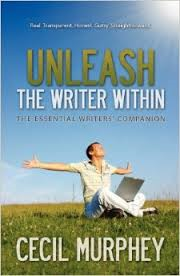
untitled (6)Unleash The Writer Within by Cecil Murphy is a relaxed and encouraging read. It’s an easy commitment that you’ll be able to finish in a few days.

The chapter titles make for a quick reference guide, directing you to different areas of your writing that you may need to work on. I could see this book becoming a handy tool that a writer might revisit as needed.

Each chapter ends with a motivational saying that might seem trite at first but are the very words often bandied about many writing websites, Facebook, and Twitter. They prove to be little jewels of wisdom, perfect for lifting yourself out of the writing doldrums.

When you need to step away from writing for a few days due to writer’s block, reading this book would be a good use of your time to help free your inner muse.

The Standards of Prose – Realistic or Ridiculous?

imagesWho gets to decide what makes something good? Or great? I’ve often asked this question about art, books, and movies especially after I’ve read a review.

Does a critic have to possess a degree in the field they are critiquing? Must they successfully produce vast quantities of work in said field before they qualify as worthy to deliver an opinion? Or does simply earning a lot of money doing what they enjoy make them an expert in the field? And, most importantly, do we listen without question when they cast their vote for yea or nay?

These questions have been on my mind as I edited the fourth draft of my novel, The Secrets of Dr. John Welles. Admittedly, I have been (WARNING: cliché ahead) tying myself up in knots trying to predict what the agents I will query, the publishers they will solicit, and any potential readers may want out of my novel. Along the way, I may have even foolishly surrendered what I wanted from my book in my quest for perfection.

Recently, I tortured myself with chapter one rewrites until I met with my level-headed, best friend who talked me through my dilemma and put me back on track. Suddenly, writing was fun again.

But I’d be lying if I said I didn’t have a pea under the mattress of my brain, niggling me with doubts and fears. I reread the first lines, paragraphs, and pages of my favorite books, trying, without copying, to capture the essence of what made them great according to my perception of greatness.

About this time, I came across a brilliant essay written by Daniel Wallace titled Sentence Anxiety. Mr. Wallace eloquently stated exactly how I feel about the standards of prose to which writers must aspire if they want to be considered real writers and/or great writers. I enjoyed the entire essay, but I believe the following paragraph, my favorite, contains the spirit of the piece:

I suspect that most common readers — people who read novels but are not professionally connected to literature — simply don’t read like this. Not only do such readers lack the stylistic precision to tell actual bad writing from, say, Nabokov or Joyce amusing themselves with marginally overblown prose, such readers do not approach books with the professional reader’s exhaustion, his frantic need for newness. Few common readers, I humbly posit, read the opening pages of Harry Potter and the Philosopher’s Stone and cry, “Oh, God, not another school-based bildungsroman!”

After reading the complete article, I would love to hear your opinion on the subject.  In the meantime, I’m going to continue putting all of my efforts into creating my novel. My goal is to not only write good and great sentences, but to write an enjoyable novel that readers will find hard to put down, a book that they will recommend to their friends and family, and a story that will stay with them long after its conclusion.

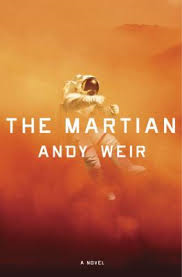
The Martian by Andy Weir

The Martian by Andy Weir is an enjoyable read. I’m not sure it was the best choice in books as I was still coming down from my high after Night Train to Lisbon, but light reads are good for balancing out the heavy stuff.

Written mostly as journal entries by abandoned astronaut, Mark Watney, the endless explanations on the necessary procedures conducted to survive life on Mars were tedious. I often felt as if I was reading an article from National Geographic or a really interesting survival manual. I skimmed a few descriptions until I found the story again.

Andy Weir has proven that he knows his technical stuff, but he delivers it inelegantly and without passion. I don’t need to know exactly how many molecules of various elements are produced when splitting hydrazine nor do I need to know how much power is required to do so. All I need to know is that it’s dangerous. Besides, how many of us could actually refute the science?

untitled (5)The diary entries came across as mild locker room humor mixed with surfer dude attitude and undermined any real tension in the plot. We’re told this is how Mark Watney deals with stressful situations. A more professional approach on the part of the main character with less “ugh, whee, yay, and boo” in his responses would have gone a long way to making me believe in the seriousness of the situation and that he was a highly educated person suitable for space travel.

We’ve been here before with Apollo 13, Castaway, and mostly recently, Gravity. Even Robinson Crusoe was a survivor story. The Martian lacks in respect to these stories because beyond saving Mark, there is no human side to the story. There is no wife or girlfriend waiting on Earth, no foul play to his situation that he needs to discover, not even a friend to whom he needs to make an apology for having spoken harshly. In short, there’s not much in the way of human interest for Mark Watney.

The second way in which The Martian differs greatly from these stories is that it’s pure fantasy. Obviously Apollo 13 is real and the other tales could actually happen. Travel to Mars and/or survival on Mars is still pretend. I find it’s easier to relive historical tragedies than get caught up in the drama of make believe. But that’s just me.

The story was mildly predictable in terms of the sequence of trials and tribulations Mark had to endure on Mars. No sooner would he triumph, I’d turn the page and right on cue the next crisis would appear. The constant up and down was interesting but not as suspenseful as everyone is claiming. This is most evident when thirty pages into the book, Mark wonders if he’s going to blow himself up undertaking an experiment. With about 92% of the book left to go, I’m pretty sure he’s not going to die. Result: zero tension.

Still, Andy Weir’s book is fun. If you’ve worked your way through all your DVDs of Star Wars, Star Trek, and Dr. Who, I recommend reading The Martian. If you’re not a reader, you can wait for the movie which, according to IMDB, is due out in November, 2015.

Favorite Author & Multi-Book Review

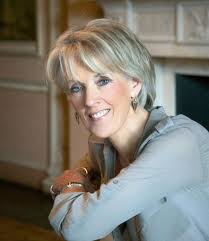
untitled (6)Joanna Trollope is my favorite writer when it comes to working through the family situation. Her well-written characters are as diverse as the personalities one encounters in his or her own family and just as frustrating. I’ll no sooner have my favorite characters chosen only to have him/her say or do something completely stupid, and my allegiance changes to the character I used to hate. In this way, Mrs. Trollope reels you in and casts you back throughout the story.

The way in which she presents real-life, everyday situations isn’t boring in the least. Her ‘fly on the wall’ perspective into the lives of her characters offers the same guilty pleasure as witnessing private conversations and/or arguments.

Further, her conclusions aren’t always neat and tidy happy endings. Much like real life and family, there is a definite end to the situation, but rarely does it go well for everyone. You’ll struggle, suffer, rejoice, and celebrate right along with Mrs. Trollope’s characters, often identifying with them or recognizing them in your own family members.

I haven’t read everything written by this author, and I haven’t experienced her writing under her pen name Caroline Harvey. What I have read has been enjoyable, the most recent being Daughters in Law. Her novel, Other People’s Children, received my strongest reaction. As expected, the book is replete with interesting characters in different walks of life. There is, however, one character in particular who I fantasized killing in the most heinous ways imaginable long after I had finished reading the book. That may sound horrible, but I believe it’s testimony to Joanna Trollope’s excellent writing skills.

Here is a list of Joanna Trollope’s novel in order of publication.

To NaNoWriMo, or not to NaNoWriMo, that is the question

I first heard about NaNoWriMo two years ago from my friend who heads our Writer’s Group. The idea of writing 50,000 words (an entire novel) in thirty days was both exciting and terrifying. As luck would have it, I had been kicking around an idea for a great novel. NaNoWriMo seemed like a good way to get the story out of my head and onto paper.

Before NaNoWriMo, I wrote short stories and children’s stories of picture book length. I had never heard of outlining a novel which might have been helpful for my first NaNoWriMo experience. Undaunted, I began writing near the end of the book leading up to the scene that was the catalyst for the whole novel. That’s when I realized I needed to go back to my character’s beginning. My first experience with NaNoWriMo was a jumbled mess.

I reached my goal of 50,000 words but didn’t have a complete novel. There was more to the story than I originally thought. The rest of the year was spent creating those portions while editing and chucking large sections of what I wrote for NaNoWriMo. I began to wonder if my November efforts had all been for naught when NaNoWriMo rolled around again. What to do?

I cheated again. I used the 50,000-word goal to keep writing new stuff my novel needed and editing what I had written last year. Perhaps the Deities of NaNoWriMo would smack my fingers with a ruler for this, but I justify what I did with the explanation that at least I wrote.

This year marks the third NaNoWriMo since I first participated. I didn’t join. I also didn’t use it as a motivational tool for rewrites and editing. I let myself off the hook with the understanding that my schedule and novel were in different places than what NaNoWriMo required. In short, I didn’t have the time and there wasn’t anything new to write or edit to meet the word count. I also didn’t want to start another novel when I already had one under way.  I’m not sorry for having tried NaNoWriMo, and I’ll probably do it again. In the meantime, I shall continue working on my second round of editing and looking for beta readers.

If you’re trying to decide whether or not NaNoWriMo is for you, consider the following article by Christopher Shultz. He’s much more eloquent in his explanation of what one needs to consider before jumping feet first into NaNoWriMo without knowing what it’s all about. I agree with his opinion that one should make NaNoWriMo work for him/her and that it isn’t a ‘must’ or ‘mustn’t’ situation in the life of a writer.

Dripping Ink – Questions for Self-critique

The Writer Has the Last Word

It is my very great pleasure to share an article by Caroline Totten of The Greater Canton Writers’ Guild, Inc.  The following article was featured in the September newsletter.  Information regarding the Guild can be found at:  http://cantonwritersguild.org/

Dripping Ink by Caroline Totten

Questions for Self-critique

Do your demons imitate the gods by grabbing and holding attention? (Your demons are ideas that keep poking you in the eye. If the idea arouses laughter, tears, paranoia, fright, curiosity or indignation, etc., you have acquired a point of view, which may boil into a plot.)

Does the plot offer an opportunity to provide fresh insight into the theme? (Ideally, the plot begins with a distress signal in the middle of the story. The action is already in progress and tinged with an emotional element in the main character. Usually, the setting fits the character and supports the viewpoint.)

Is the character(s) consistent in the context of the plot? (Draw the emotional tone from your personal experience and place it in the persona of the protagonist, the main character. The conflict may be psychological, physical, or ideological, or a combination of these elements.)

Here are a few aspects of the reader/author relationship to keep in mind. By being a writer, or hoping to become one, your entire self becomes an instrument to observe and record human experience. When you extrapolate heartache, joy, fear, whatever, and put them into your character, you are actually putting the reader in touch with his emotions. (Numbness, repression, or suppression are emotional factors.)

Psychologically, mystery, or suspense stories excite the mind of the reader.

Horror stories, by a circuitous route, help the reader release his fear.

Adventure stories encourage bravery.

Love stories release hormones that tenderize the heart.

Fantasy encourages imagination by offering another way of perceiving the resolution of conflict even though at the outset, the reader may be looking for escape.

Humor may release attitudes that might otherwise be socially rude or crude.

Actually, stories that contain violence, corruption, and greed may contribute to the reduction of these elements and/or act as a catharsis for the reader.

Reading fiction is not an idle past time. Its factual component may differ from nonfiction, but the result is similar. The point of view alters the reader’s perceptions.   Effective writing heightens awareness of the subject by allowing the reader to participate in the physical and mental experience of the character. Most effective stories show the character in action. In some cases, “thinking” by the character rather than dialogue or confrontation may be the entrance into a story. The approach depends on the genre, your style, and editorial desires. (At times, magazine and book editors don’t know what they want until they see it.)